
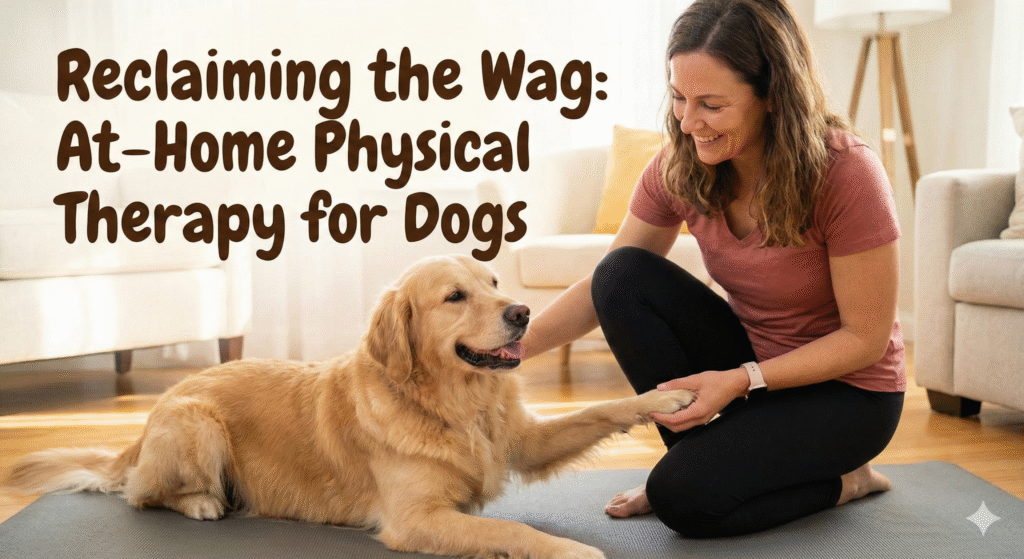
Reclaiming the Wag: A Loving Guide to Physical Therapy Exercises for Dogs
Every dog owner knows of a certain form of heartbreak. This is the point at which you feel the indecision. Perhaps it is the manner in which your Golden Retriever or Dachshund first stalls before leaping into the car, or how terribly the old dog of your family, your senior Lab, can walk on a cold winter morning.
We are so passionate about them, are we? They are our dark sides, our friends, and our kith. In the moment when their bodies begin to slow down, either through surgery or injury or simply through the unstoppable workings of time, then we too, tend to feel powerless. But I am here to make you know that you are not powerless. As a matter of fact, you are the greatest weapon in the recovery arsenal of your dog.
And we can recover the spark with the aid of certain motion and attention. We will discuss some physical therapy exercises you can perform on your dogs at the comfort of your home in this guide. They are not medical processes, but will be love-making and muscle-making and confidence-making and bonding making without words.
Why Physical Therapy Matters (More Than You think)
Whenever we mention the word physical therapy, we immediately recall the picture of sterile clinics and underwater treadmills. Even though professional rehabilitation is crucial, it is stability of home care where magic can be performed.
Exercising with the physical therapy of a dog is not only about healing a limp. It concerns the holistic wellness. Once a dog becomes immobile, they have lost a part of their personality. They are not able to patrol the yard, run after the ball, or even run after you to the kitchen. Through such exercises, you will offer:
Pain Control: light exercise oils the joints and lowers swelling.
Mental Stimulation: Learning new movements is a battle against the depression which usually comes with injury.
Muscle Retention: It is more difficult to build up what has been lost and it is simpler to avoid atrophy (muscle loss).
Proprioception: Training your dog to be aware of the position of its feet.
Anna’s Note: Before we start I want you to swear me one thing. Look at your veterinarian or a canine rehabilitation therapist (CCRT). Workouts with your dog need to be based on your dog’s condition. This may be the cure to an aching hip but could be the soreness to a ruptured ACL. Our word of love is safety.
The Golden Canine Rehab Rules.
1. Warm Up the Engine
You would never get up the second time you woke up and run a marathon, and you should not make your pup. Skeletal muscles are likely to be injured when it is cold. Whilst performing any physical therapy on dogs, warm the area of the body with a warm pack (a towel fresh of the dryer will perform some miracles) 10 minutes beforehand or take a very slow and short walk to get the blood going.
2. The Power of Positive Reinforcement.
We would like your dog to have these sessions to be associated with happiness and not suffering. Always carry around some high value treats in your pocket. If they try, they get a reward. In case they are winners, they are jackpot.
3. Slow and Steady
The process of recovery is a marathon and not a sprint. When your dog indicates that it is tired, i.e. overly panting or trembling, or walks away, shut it down.
Phase 1: Passive Range of Motion (PROM)
Best: Dogs that have undergone surgery, the unstable pets or pets with severe arthritis.
In the event that your dog is now too weak to stand or move a limb at will, Passive Range of Motion (PROM) is what the recovery is based on. This is the part you are taking up for them.
The Bicycle Motion
This is among the least dangerous physical exercises of dogs.
Position: Place your dog on his or her side, on a tight and soft area (yooga mat or carpet). The leg with the painfulness should be elevated.
Support: Support the limb above the knee and below the knee.
Action: Move the leg slowly in a natural movement in a motion that resembles the motion of peddling a bicycle. Flex the ankle (hock), flex the hip and bend the knee.
Extension: Straßen, durchstreckt.
Repetition: 10 to 15 slow repetitions.
Why it works: It maintains the movement of the synovial fluid within the joint capsule, and avoids freezing up of the dog without having to load the joint with weight.
Phase 2: Active Help and Support.
Best: Dogs that are weak or wobbly but are able to stand.
When your dog is old enough to support a certain weight, then we transition into dog physical exercises. This phase is aimed at balance and core strength.
The Supported Stand
In dogs that have lost the habit of standing we must reteach the muscles how to discharge.
Position dog: This is to place your dog in a standing position on a firm surface without slip.
Position: Have your hands below or under their stomach or place a rehab sling towel or a towel below their abdomen to relieve some of them of their weight.
Action: Have them care on all four paws. In case they knuckle over (toes bending underneath), lay the paw flat.
Time: Have a goal of 10 seconds, and then on to a minute.
Weight Shifting
This is subtle but incredibly effective among physical therapy exercises for dogs.
Position: With your dog standing (supported if necessary), kneel beside them.
Action: Place your hands on their shoulders or hips. Very gently rock their body slightly side-to-side.
Goal: You want to feel them engaging their muscles to resist your push and maintain their balance. This forces them to shift weight onto the weak leg without realizing it.
Phase 3: Strengthening the Hindquarters
Best for: Dogs with hip dysplasia, knee issues (CCL/ACL), or senior weakness.
The hind legs are the engine of the dog. When the engine weakens, the dog compensates by pulling with their front legs, leading to shoulder pain. These physical therapy exercises for dogs target that rear-end weakness.
Sit-to-Stand (Puppy Squats)
This is essentially weightlifting for dogs. It targets the glutes, quads, and hamstrings.
Setup: Stand facing your dog.
The Sit: Ask your dog to “sit.” Ensure they sit squarely (knees tucked in, not flopped to one side). If they flop, use a wall on one side to guide them.
The Stand: Immediately ask them to “stand,” luring them forward slightly with a treat so they push up with their rear legs rather than pulling up with their front.
Repetition: Start with 5 repetitions. This is tiring work!
Curb Walking
The world is your gym! This is one of the easiest outdoor physical therapy exercises for dogs.
Find a Curb: Locate a long, low curb or a stable platform.
The Movement: Walk your dog so that their healthy legs are on the road and their weaker legs are up on the curb.
The Effect: This uneven walking forces the dog to bear more weight on the limb on the curb (or the road, depending on the injury—consult your vet on which side needs the load). It also improves body awareness.
Phase 4: Proprioception (Body Awareness)
Best for: Neurological issues, clumsy dogs, and spinal recovery.
Sometimes, the brain forgets where the feet are. Proprioceptive physical therapy exercises for dogs re-map the neural pathways.
Cavaletti Rails (Step-Overs)
You don’t need professional equipment for this. Broomsticks, pool noodles, or rolled-up towels work perfectly.
Setup: Lay 3 to 5 poles on the ground, spaced apart roughly the distance of your dog’s stride.
Height: For beginners, keep them on the ground. For advanced rehab, raise them 2-3 inches.
Action: Walk your dog slowly over the poles.
Goal: The dog must pick up their feet rather than dragging them. This builds hip flexor strength and coordination.
The Wobble Board
Balance boards aren’t just for human yoga.
DIY Option: If you don’t have a wobble board, a sofa cushion placed on the floor works well.
Action: Have your dog stand on the unstable surface. The micro-movements they make to stay upright fire up the core muscles and stabilizers around the joints.
Progression: Ask for a “sit” or “high five” while they are on the cushion to increase the difficulty of these physical therapy exercises for dogs.
Phase 5: Advanced Functional Movements
Best for: Athletic dogs returning to sport or final stages of recovery.
When your dog is ready to graduate, we introduce functional physical therapy exercises for dogs that mimic real-world activity.
Figure-8 Walking
Walking in a straight line is easy. Turning is hard.
Setup: Place two cones (or chairs) about 6-10 feet apart.
Action: Walk your dog in a figure-8 pattern around the objects.
Benefit: This forces the dog to bend their spine and load weight onto the inside and outside legs alternately. It improves lateral stability and spinal flexibility.
Hill Work
Gravity is a great therapist.
Walking Uphill: Shifts weight to the hindquarters, building power in the hips and thighs.
Walking Downhill: Shifts weight to the front, controlling the shoulders and requiring braking power (eccentric contraction) from the rear legs.
Walking Across a Slope: Helps with balance on uneven terrain.
Also Check- Best Winter Coats for Dogs – Warm, Waterproof & Comfy Picks for Every Pup
The Emotional Component: Patience is a Virtue
I want to take a moment to speak to you, the caregiver. Implementing a routine of physical therapy exercises for dogs can be frustrating. There will be days when your dog refuses to cooperate. There will be days when you feel like you aren’t making progress.
Breathe.
Healing is non-linear. Some days are leaps forward; others are steps back. What matters is that you are showing up. Every time you get on the floor to do these exercises, you are telling your dog, “I am here. I’ve got you.”
Signs of Pain to Watch For
While performing physical therapy exercises for dogs, be hyper-aware of these distress signals:
Lip licking or yawning (signs of stress).
Turning the head to look at the area you are touching.
Whimpering or growling.
Refusal to use the limb the next day.
If you see these, stop. Rest for 24 hours. Reduce the intensity next time.
Sample Weekly Schedule
To help you integrate physical therapy exercises for dogs into your busy life, here is a sample schedule for a dog in mid-stage recovery.
| Day | Morning | Evening |
| Mon | 10 min Warm Walk + Passive Range of Motion | 5 min Sit-to-Stand + Massage |
| Tue | 15 min Leash Walk | Balance work (Cushion standing) |
| Wed | Rest Day (Short potty walks only) | Rest Day (Cuddles required) |
| Thu | 10 min Cavaletti Rails (Step-overs) | Figure-8 Walking |
| Fri | 15 min Leash Walk (Try gentle slopes) | Passive Range of Motion |
| Sat | Rest Day | Rest Day |
| Sun | Fun Day! Short walk + Mental games | Massage & Stretching |
Conclusion: The Road to Recovery
Now you happen to see the injury by looking at your dog. You may be shown the gray muzzle or the surgical scar. However, when I look at a dog that is in a rehab, I think of a warrior.
It is a commitment and yes, it is a commitment to take into consideration some physical therapy exercises on your dog to make it part of your daily routine. However, the payoff is in watching the tail wagging a bit more, the running going back to their pace and the light going back to their faces. you are making them the present of motion, and no present is better than that.
Take it one day at a time. One paw in front of the other. This you and your best friend have got.
Insta- The Dogs USA
Pingback: 5 Best Mental Stimulation Toys for Dogs - The Dogs USA