
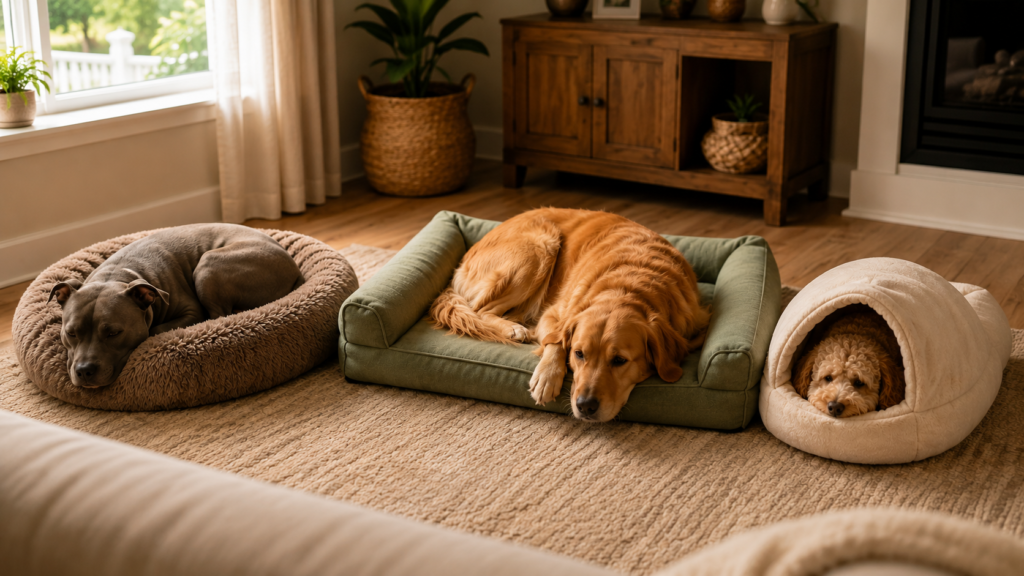
I have three dogs — a 60 lb Pitbull, a 75 lb Golden, and a 45 lb Doodle — and for a while I made the same mistake a lot of dog owners make: I assumed if a calming bed worked for one, it would work for all of them. It didn’t. What calmed my Pitbull down did almost nothing for my Doodle, and my Golden just looked uncomfortable in both.
That’s when I started paying closer attention to what each of them actually needed, and it came down to three things every time: their size, their nature (how they sleep when they’re relaxed), and their breed traits. I call it the S.N.B. Formula, and once you know it, picking the right bed stops being a guessing game.
Here’s how to figure out what your dog needs.
Meet the S.N.B. Formula: Size, Nature, Breed
Step 1: Start With Their Size
This one matters more than people expect, because physical discomfort makes anxiety worse, not better. The base of the bed has to match their frame.
Small dogs (under 25 lbs): Little dogs tend to feel exposed in open spaces, and they lose body heat fast, especially when they’re stressed. What they usually respond to is something ultra-plush that traps warmth — it mimics the feeling of curling up against a mother or littermate.
Medium dogs (25–50 lbs): These dogs are usually the easiest to shop for. Structure matters less here — for them, it’s really about the shape of the bed, which is Step 2.
Large and giant dogs (over 50 lbs): A standard poly-fill bed flattens fast under a heavier dog, and once their hips are hitting the hard floor underneath, the joint stiffness just adds to the restlessness. Bigger dogs need an orthopedic or memory foam base if they’re going to actually relax into it.
Step 2: Watch How They Sleep When They’re Calm
Every dog has a way they naturally try to self-soothe. Watch them when they’re relaxed and you’ll usually see one of these three patterns.
The Curler — tucks into a tight ball, almost instinctively, like they’re protecting themselves. These dogs tend to do well with a round, deep-dish donut bed. The raised rim gives them something to press against, similar to how a weighted blanket works for us.
The Burrower — tries to dig into your couch cushions, blankets, or hide under furniture. This dog is trying to block out whatever’s overwhelming them — visually and sound-wise. A covered cave bed does that job for them.
The Sprawler — stretches all the way out but still wants to keep an eye on the room. This dog usually does best with a rectangular bolster or sofa-style bed — something that gives them a “wall” at their back while leaving room to stretch.
Step 3: Factor In Their Breed
Last piece of the puzzle — what your dog’s body or breed history brings to the table.
Flat-faced breeds (Pugs, Frenchies): A lot of owners find bolster beds work well here, mostly because these dogs like resting their chin on a raised edge.
Thick-coated breeds (Huskies, Malamutes): Overheating causes real physical discomfort for these dogs, so skip the heavy faux fur. An orthopedic bed with a breathable or cooling cover is usually the better call.
High-alert hounds and terriers: These breeds were bred to notice everything, which makes it hard for them to switch off. A dark, enclosed cave bed often helps them finally let their guard down.
Putting It Together
Example 1 — the large anxious dog
Say you’ve got a 70 lb German Shepherd who sleeps stretched out and has a thick double coat. Size says large, nature says sprawler, breed says avoid overheating. Put that together and you land on an orthopedic bolster bed with a cooling cover — not a fluffy donut bed, which would run too hot and wouldn’t fit him properly anyway.
Example 2 — the tiny nervous dog
Now take a 12 lb Miniature Dachshund who hides under blankets during storms and has that classic hound alertness. Small, burrower, high-alert — that combination points to a heated cave bed. The hood blocks the storm from view, and the enclosed space holds in the warmth she needs when she’s shivering.
That’s really it. Once you run your own dog through Size, Nature, and Breed, the right bed usually becomes pretty obvious — even if it’s not the one you would’ve picked off a shelf.
Pingback: Best Dog Bed for Anxiety, Tested on 3 Dogs - The Dogs USA