
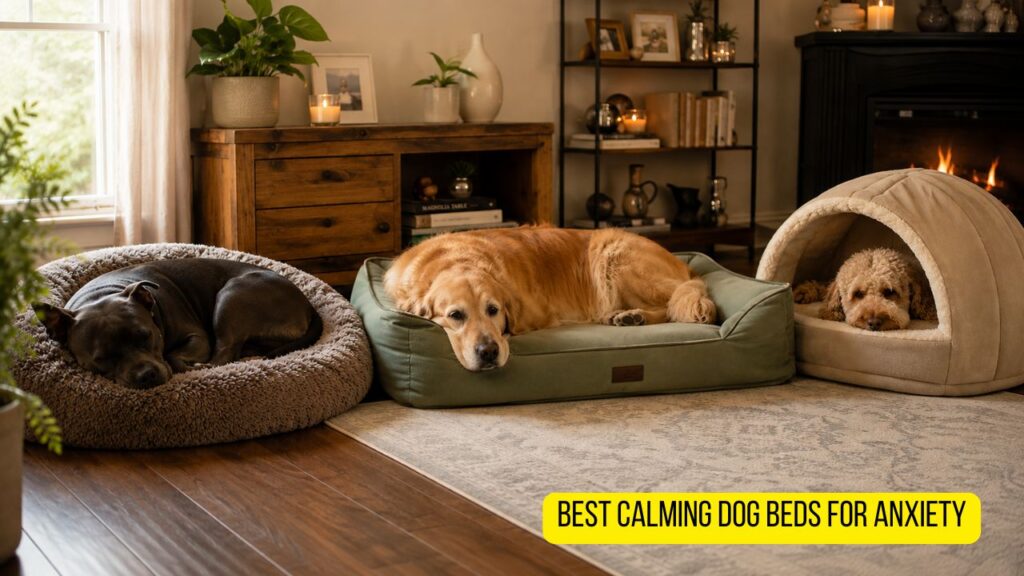
When I brought my rescue Pitbull home a year ago, the separation anxiety was heartbreaking to watch. If you’ve got a nervous dog, you probably know the signs — the pacing by the door, the panting that has nothing to do with heat, the way they just can’t seem to settle even when nothing’s actually wrong.
Between him, my Golden Retriever, and my Doodle, I’ve got three very different dogs with
For older anxious dogs: If your dog is a senior with stiff joints, see my Best Dog Bed for Senior Dogs with Arthritis. And mental enrichment helps anxious dogs settle — check out my 5 Best Mental Stimulation Toys for Dogs.
three very different anxiety triggers — and I learned pretty fast that a flat mat from the pet store wasn’t going to do much for any of them. What they actually needed was something that made them feel physically secure, not just something to lie on.
So I went looking for the best dog beds for anxiety, tested a handful on my own pack, and figured out what actually works and why. Suppose you’re wondering whether calming beds even help, honestly, yes, but only if you pick one that matches how your specific dog tries to calm themselves down. Here’s my real, tested-on-my-own-pack guide.
What Actually Makes the Best Dog Bed for Anxiety Work?
Before you buy anything, here’s what to actually look for:
Raised rims (bolsters): Give your dog a sense of a boundary — somewhere to rest their head and feel a little more tucked in.
Faux fur or shag material: Mimics the feel of a mother or littermate, which taps into a pretty natural calming instinct.
Deep crevices or covers: Let your dog burrow and block out whatever’s setting them off — great for storm or firework anxiety.
How Do You Know Which One Your Dog Needs?
Here’s the thing — before you add anything to your cart, it’s worth figuring out what kind of anxiety your dog actually has, because the wrong bed just sits there unused.
After years of trial and error with my three, I ended up putting it into something I call the S.N.B. Formula — Size, Nature, and Breed. It’s basically: does your dog need heat retention or orthopedic support (size), do they curl up, stretch out, or burrow (nature), and does their coat or breed history change what they need (breed traits)? Get those three right and you’ve basically already found the bed.
👉 I actually broke this whole thing down in detail here: [The S.N.B. Formula: How to Choose the Perfect Dog Bed for Anxiety]
Alright — here’s what actually worked for my three.
1. The Deep-Dish Donut Bed — Best for Severe Anxiety
🏆 The one that saved my rescue Pitbull
When a dog is really anxious, curling into a tight ball is usually their first instinct — it’s a self-protective thing. Donut beds are built around that exact posture.
My Pitbull used to start shaking the second I grabbed my car keys. I put a deep-dish, faux-fur donut bed in the quietest corner of the living room, and something about that raised rim — it kind of hugs his body, similar to how a weighted blanket works for us — actually got through to him. Within a week, that bed had become his spot. The place he went to when I left for work, no coaxing needed.
Best for: Dogs who curl up tightly, deal with separation anxiety, or seem to need that physical pressure around them to settle.
2. The Orthopedic Bolster Bed — Best for Large Breeds
🏆 My Golden Retriever’s favorite
Big dogs get anxious too — people forget that. But a small, fluffy donut bed usually isn’t comfortable for a large dog’s joints, and if they’ve got a thick coat, all that faux fur just makes them overheat.
For my Golden, we went with a rectangular bed — memory foam base, bolsters on three sides, basically like a mini couch. It gives his 75-pound frame the support he actually needs, and the bolsters give him a corner to tuck into when things get loud, while the open front still lets him stretch out without cooking himself.
Best for: Large breeds, senior dogs with stiff joints, or sprawlers who want a wall behind them but still need room to stretch.
3. The Covered Cave Bed — Best for Burrowers
🏆 My Doodle’s hideout
Does your dog dig into your couch cushions or try to bury their head under a pillow when they’re nervous? That’s basically my Doodle’s whole personality when she’s stressed.
Cave beds — sometimes called hooded or nesting beds — have a built-in cover that stays propped open, and it just satisfies that denning instinct dogs have. When she’s overwhelmed by a thunderstorm or too much noise in the house, she goes straight for it. The hood blocks the light and muffles the sound, and honestly it’s probably the single best tool I’ve found for an easily overstimulated dog.
Best for: Small to medium dogs, natural burrowers, or hounds and terriers who need a dark, enclosed space to actually switch off.
My Take: Getting Your Dog to Actually Use the New Bed
Don’t worry if your dog doesn’t jump straight into their new bed — that’s normal. Here’s what’s worked for me every time:
Scent matters more than you’d think. Drop an unwashed t-shirt that smells like you right in the middle of the bed.
Location matters too. Put it somewhere quiet, away from all the foot traffic — not in the middle of the living room.
Let them come to it. Toss a few treats in and praise them when they step in on their own. Never force them inside — that kind of defeats the whole point.
Real Questions I Get From Other Dog Owners
Whenever I talk about calming beds — at the dog park, on Instagram, wherever — I end up getting asked the same handful of questions. So here’s the honest, no-fluff version of what I tell people.
“My anxious dog destroys every bed I buy. Will a calming bed even survive?”
Honestly? Probably not, if they’re in a heavy chewing phase. When I first brought my Pitbull home, a lot of his anxiety came out as destructive chewing, and no fluffy donut bed is built to survive that. If your dog’s still in that stage, save your money for now — work on the chewing first with something like a heavy-duty KONG, and stick to a durable, chew-resistant mat until things settle down. The calming bed can come later.
“How do you even wash these fluffy shag beds without wrecking them?”
This is honestly the most annoying part of owning one. My rule: always buy a bed with a removable cover, no exceptions. I wash mine on a cold, delicate cycle, and the one thing I never do is put faux fur in the dryer on high heat — it’ll melt the fibers and mat everything together, and there’s no coming back from that. Air dry it over a chair instead, then just fluff it back up by hand once it’s dry.
“Should the bed go in their crate, or out in the living room?”
Depends on where your dog naturally goes when they’re scared. If your dog already treats their crate like a den, a calming pad inside works great — just make sure it’s not so bulky they can’t stand up comfortably. For my Doodle, though, we keep her cave bed in a quiet corner of the living room. She wants the noise to stop, but she still wants to know we’re close by.