
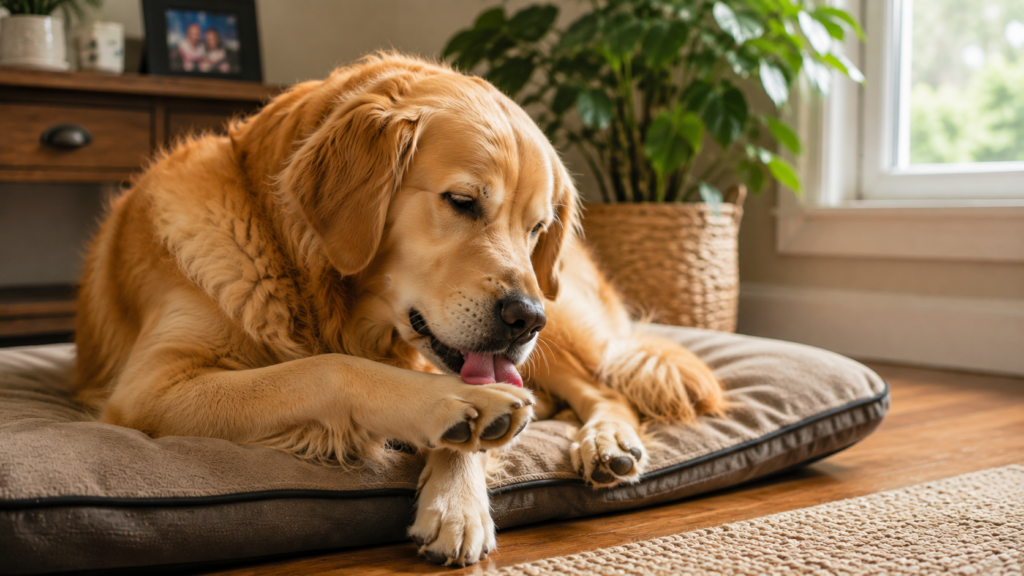
Every dog owner knows that sound — the slow, wet slurp-slurp-slurp coming from the corner of the living room at 11 pm, right when you’re trying to fall asleep.
A little paw licking here and there is just normal grooming. But when it turns into something obsessive, or it’s the thing waking you up at night, that’s your dog telling you something’s off. Between a sensitive rescue Pitbull, an allergy-prone Golden Retriever, and an adventurous Doodle, I’ve genuinely seen every version of the paw-licking spiral.
Here’s the thing — before you panic, you kind of have to play detective. There are a few different reasons why dogs lick their paws, and figuring out which one applies to your dog is really the only way to actually get them relief.
The Usual Suspects
Before assuming the worst, run through these four first:
Environmental allergies — pollen, grass, dust mites absorbing right through the paw pads.
Something physically stuck — thorns, burrs, glass, winter salt wedged between the toes.
Anxiety or boredom — licking as a self-soothing habit when they’re stressed or under-stimulated.
Yeast or bacterial infection — usually shows up after the licking’s already been going on a while, caused by all that extra moisture.
1. Environmental Allergies (Probably the Most Common One)
Dogs don’t really get hay fever the way we do — no sneezing fits. Instead, it shows up as itchy skin, especially the paws and belly, since those are in direct contact with the ground all day.
I can basically predict allergy season now. When my Golden’s paws start turning pink and he’s furiously chewing at them after a walk in the park, I already know what’s going on. Allergens get absorbed right through the paw pads — it’s kind of like they’ve got a mosquito bite wedged between every toe.
What actually helps: wiping their paws down with a damp cloth or a hypoallergenic wipe the second they come back inside from grass. Sounds too simple, but it makes a real difference.
2. Anxiety and Stress (The Emotional Licker)
Licking actually releases endorphins for dogs — it’s genuinely soothing to them, which is part of why it’s so hard to just tell them to stop.
When my rescue Pitbull first came home, his separation anxiety showed up almost entirely as him obsessively licking his front right paw. If your dog starts licking around loud noises, a change in routine, or the second you leave the house, that’s probably emotional, not physical.
What actually helps: you have to deal with the anxiety itself, not just the paw. A frozen KONG or some other long-lasting chew can redirect the behavior in the moment, but longer term, having a genuine safe space matters a lot too — if you haven’t already, this is exactly what my S.N.B. framework was built for. 👉 [The S.N.B. Formula: How to Choose the Perfect Dog Bed for Anxiety]
3. Something Physically Stuck or a Hidden Injury
Before you jump to “it’s probably allergies,” actually check the paw itself. My Doodle loves crashing through thick brush on walks, and when something’s bothering her, she’ll just drop to the ground mid-walk and start aggressively licking one spot.
Gently spread the toes apart and look for:
- A thorn or foxtail buried in the fur
- Cracked or torn pads (hot pavement does this more than people realize)
- A cracked nail
- Ice melt or road salt stuck in the crevices — especially common in winter
Also Read: 5 Gentle Physical Therapy Exercises for Dogs (At-Home Guide)
4. Food Allergies
Less common than environmental allergies, but worth ruling out — some dogs react to common proteins like chicken or beef, and it can show up as skin inflammation, paw licking, and even recurring ear infections. If the licking is year-round and doesn’t seem tied to a season, and their ears are acting up too, diet might be worth looking into.
(Worth saying — I’m not a vet, and none of this replaces an actual exam. If the licking is severe, constant, or the paw looks inflamed or raw, it’s worth getting your vet to actually take a look.)
Real Questions I Get From Other Dog Owners
Whenever I post about this stuff, I get flooded with the same handful of questions. Here’s how I actually handle them.
“Why do my dog’s paws suddenly smell like Fritos?”
If you lean down and it genuinely smells like a bag of corn chips — that’s usually a sign of yeast. Yeast loves warm, dark, damp environments, and constant licking from an allergy or irritation creates exactly that. Once yeast is in the mix, it gets itchy on its own, which just makes the licking worse — it turns into a loop. At that point you’re probably looking at an anti-fungal wipe or shampoo, ideally one your vet recommends.
“Should I just put the cone on them to make it stop?”
The cone stops the licking, sure, but it doesn’t touch the actual itch or anxiety underneath it — it’s a band-aid, not a fix. Personally, I only reach for one if a paw is actually injured and needs to heal, or if the licking’s already created a hot spot. Otherwise, you’re better off finding the actual cause.
“Do paw balms actually work?”
For some things, yes. Balms like Musher’s Secret are genuinely great for hot pavement, winter salt, and dry cracked pads. But if the root cause is allergies or anxiety, a balm’s not going to touch that — it’s protecting the paw, not solving the reason they’re licking it in the first place.
Is your dog an occasional groomer or a full-blown obsessive licker? If you’re stuck figuring out which one it is, drop the symptoms in the comments or message me on [Instagram] — happy to help troubleshoot.