
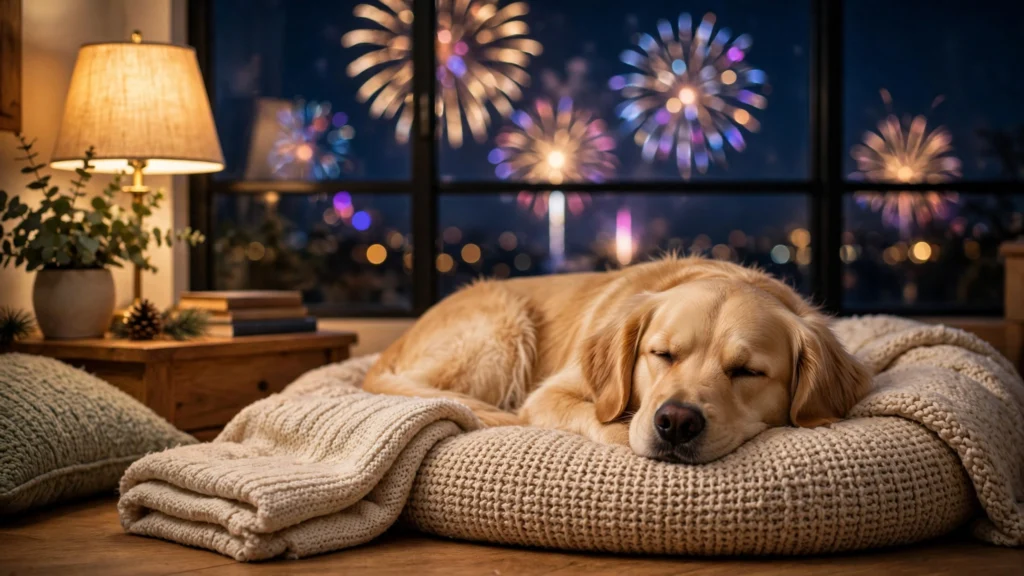
Fireworks already going off? Skip the reading. Do these five things right now: bring your dog inside (or into the most interior room), close the windows and curtains, turn on some steady background noise — TV, music, a fan — sit with them and stay boringly calm yourself, and hand out a long-lasting chew or a stuffed Kong. That’s it. The rest of this guide is for making next time easier. But tonight, those five things are the whole game.
Every December 31st, the same scene plays out in houses all over America. You’re watching the ball drop. Your dog is under the bed, shaking so hard the floorboards rattle. Maybe they’re drooling. Maybe they’re trying to claw through a door. And you’re standing there feeling completely useless, because the noise isn’t stopping for another hour and there’s nothing you can say that makes it better.
Here’s what nobody tells you: New Year’s Eve is actually the best fireworks night to plan for. Not the easiest — the most predictable. July 4th fireworks are random; your neighbor starts at 9:40, stops, starts again at 11. On NYE, you know exactly when the worst of it hits: midnight, on the dot, everywhere at once. That predictability is a gift, if you use the weeks before it.
This is the calm-dog playbook for how to keep dogs calm during fireworks on the one night a year you can see coming. The training plan that actually works, the hour-by-hour game plan for the night itself, the party-specific dangers nobody warns you about, and an honest look at the calming products — what’s worth your money and what’s marketing.
Why Fireworks Break a Dog’s Brain (a Little Science Helps)
It helps to know what your dog is actually experiencing, because “loud noise” doesn’t quite cover it. A firework burst can top 150 decibels — louder than a gunshot. Noise starts damaging ears around 120 decibels, and your dog’s hearing is far more sensitive than yours to begin with. So what sounds like a distant pop to you can land on your dog like a physical blow.
Then there’s the unpredictability problem. Dogs are pattern animals. Thunder at least comes with warning signs — the sky darkens, the air changes, the rumble builds. Fireworks give no warning. One second it’s quiet, the next the sky is exploding, and there’s no pattern to learn, no “it’ll pass in a minute” logic a dog can latch onto. That’s why the panic looks so total: from your dog’s perspective, the world has randomly started detonating.
And here’s the part that matters for training: every panicked NYE makes the next one worse. Fear rehearses itself. A dog that shook through last New Year’s Eve has already learned that midnight in December means terror — which is exactly why starting early changes everything.
The 8-Week Calm-Dog Calendar (Start Now, Thank Yourself Dec 31)
If you’re reading this in late October or early November, you’re holding a winning lottery ticket and you don’t even know it. Eight weeks is the sweet spot for desensitization — long enough to genuinely rewire the fear response, short enough that you’ll actually follow through.
The method is called counter-conditioning, and it’s the one thing every serious trainer and behaviorist agrees on for how to keep dogs calm during fireworks. The recipe is almost embarrassingly simple: play firework sounds at a volume so low your dog barely notices, and rain high-value treats the entire time the sound plays. Sound on = chicken appears. Sound off = chicken stops. You’re not training obedience; you’re changing what the noise means.
Weeks 1–2: Foundation. Find a fireworks soundscape video (there are hour-long ones). Play it at barely-audible volume — like, “is that even on?” level — while you feed tiny bits of real meat or cheese. Ten minutes a day. If your dog shows any stress — lip licking, yawning, ears back — the volume is too high. Turn it down. There is no rushing this part.
Weeks 3–5: Turn it up, slowly. Raise the volume a notch every few days, always staying under your dog’s reaction threshold. Keep the treats flowing. By week five, most dogs will hear a moderate boom, glance at you, and think “where’s my chicken?” — and that glance is the whole victory.
Weeks 6–7: Make it weird. Real fireworks aren’t a steady soundtrack; they’re random. Start playing the sounds at unpredictable times — during dinner, mid-play, while the TV’s on. Vary the volume. You’re teaching the brain that booms are background, not events.
Week 8: Dress rehearsal. The week of NYE, do a full run-through at a realistic volume while you practice your midnight routine (below). Treats, safe spot, background noise — the whole production. By December 31st, none of it should feel new.
Starting late? Read this box. If you found this guide on December 28th, skip the training calendar entirely — three days of rushed desensitization can actually make things worse by flooding a scared dog. Go straight to management mode: the night-of playbook below, the safe room, the calming aids. Management done well beats training done badly, every time. Then bookmark the calendar for next year.
For the treat side of training, it genuinely matters what you’re stuffing in your dog’s face — kibble won’t cut it against the sound of explosions. You want the good stuff, the treats they’d trade a kidney for. Our best training treats for dogs roundup is built around exactly this kind of high-stakes motivation.
The NYE Night Playbook: Hour by Hour
Midnight is the main event, but the hours around it decide how bad it gets. Here’s how to keep dogs calm during fireworks when the clock is actually ticking.
Before 6 PM: set the stage. Big walk or a solid play session in the late afternoon — a tired dog has less panic fuel. Feed dinner a little early; a full, settled stomach beats a nervous one. Set up the safe spot now, not at 11:55: an interior room (bathrooms and laundry rooms work great — fewer windows, muffled sound), their bed, a worn t-shirt that smells like you, water bowl. Plug in the Adaptil diffuser if you use one — it needs time, not a last-second plug-in. Last potty break on leash well before dark, even in a fenced yard. Fireworks start early in some neighborhoods, and a spooked dog can clear a fence you’d swear was unjumpable.
6 PM to midnight: hold the line. Close every window, curtain, and blind — it cuts both sound and the terrifying flashes. Turn on steady background noise and leave it on: classical music, a talk-radio station, a white noise machine, the TV. The goal isn’t silence; it’s making the booms less sharp by contrast. This is prime frozen-Kong territory — a mental stimulation toy stuffed with peanut butter and frozen solid can buy you a genuinely peaceful hour, because a dog working a food puzzle isn’t rehearsing panic. Act normal. Your dog is reading your body language like a book, and if you’re pacing and saying “it’s okay it’s okay it’s okay” in a panicky voice, you’re confirming there’s something to panic about. Calm, boring, matter-of-fact you is the best calming aid in the house.
The midnight hour: ride it out. This is the peak — maybe 20–30 minutes of sustained noise. If you’re wondering how to keep dogs calm during fireworks at the very worst moment, the honest answer is mostly you: your calm presence beats any gadget. Stay with your dog if you possibly can. If they want to hide, let them hide; don’t drag them out for a cuddle. If they press against you, that’s fine — hold them, stroke slowly, breathe slowly. (The old myth that comforting a scared dog “rewards” the fear has been debunked by behaviorists for years. Calm comfort doesn’t reinforce panic; it just tells them they’re not alone in it.) Keep the treats coming for any brave moment — a glance at you instead of the window, a sigh, lying down. You’re marking courage, however small.
After: don’t rush the all-clear. Sporadic fireworks can go on until 1–2 AM. Keep the setup running until the neighborhood is truly quiet, then let your dog decompress at their own pace. Some dogs bounce back in minutes; some need a day. Both are normal.
The NYE-Party Edition: Guests, Doors, and Champagne Problems
Here’s what makes New Year’s Eve uniquely dangerous compared to July 4th: the party. And parties create a whole second layer of risk that has nothing to do with noise.
Doors. Guests arrive, guests leave, someone props the front door open while carrying in a cooler. A panicked dog sees an open door as an exit from the scary place, and once they’re out in the dark with fireworks going off, they run blind. Put a baby gate in the hallway, brief every single guest (“the dog stays inside, no exceptions, don’t hold the door”), and consider keeping your dog in their safe room once the party starts — with a sign on the door if your guests are the forgetful type.
Party food and drinks. NYE spreads are a minefield: chocolate everywhere, onion-heavy appetizers, grapes on the charcuterie board, and sugar-free desserts hiding xylitol (which can be deadly to dogs even in small amounts). Alcohol is the big one people forget — a dog lapping spilled champagne or eggnog can get alcohol poisoning fast. If your dog grabs something they shouldn’t, don’t wait to see what happens: ASPCA Animal Poison Control is (888) 426-4435 and Pet Poison Helpline is (855) 764-7661. Save both in your phone now. Our Thanksgiving food safety guide covers the full toxic-food list, and nearly all of it applies to a NYE buffet too.
Home alone. If you’re going out and the dog’s staying home, everything above still applies — set up the safe room, the noise, the Kong, and ideally a pet sitter or a trusted friend who can sit through midnight with them. A camera helps you check in, but it can’t open a door or offer a hand to lean on. And please: no “quick” unsupervised potty breaks after dark on NYE. Leash, even in your own yard, every single time.
Calming Aids, Honestly Compared
Let’s talk products, because when people ask how to keep dogs calm during fireworks, half the answers they get are trying to sell them something. The internet will happily sell you seventeen gadgets and most won’t do much. Here’s the honest breakdown — what each one actually does, who it’s for, and where the marketing ends.
| Aid | What it does | Best for | Honest caveat |
|---|---|---|---|
| ThunderShirt (pressure wrap) | Gentle, constant pressure around the torso — like a sustained hug | Situational panic: fireworks, storms, vet visits | Does nothing for some dogs; fit has to be snug to work |
| Adaptil diffuser (pheromone) | Releases a synthetic copy of the calming pheromone mother dogs produce | Background anxiety at home; multi-week buildup | Needs weeks of lead time; won’t stop full-blown panic alone |
| Calming chews | L-theanine, valerian, chamomile and similar botanicals take the edge off | Mild-to-moderate nerves, as a companion to other tools | Mild effect at best; check with your vet if your dog takes medication |
| SILEO (prescription) | FDA-approved gel that calms noise fear without sedating | Dogs with severe, established noise phobia | Vet prescription only; plan ahead, not a NYE-morning decision |
Disclosure: As an Amazon Associate I earn from qualifying purchases, at no extra cost to you. This helps support TheDogsUSA and allows us to keep creating helpful dog guides.
ThunderShirt Classic Dog Anxiety Jacket
The original pressure wrap, and still the one vets mention first. The idea is simple — gentle, constant pressure around the torso, the way swaddling calms a baby — and in the company’s 2022 survey, over 85% of owners said it helped their dog’s anxiety. No training, no pills, no waiting weeks: you put it on about 15 minutes before the noise starts. It’s the rare calming product that can actually help tonight, which is why it tops this list. Just measure your dog’s chest before ordering — a loose wrap is a useless wrap.
Check the ThunderShirt on Amazon
ADAPTIL Calm Home Diffuser (30-Day Starter Kit)
This is the slow-burn option. The diffuser plugs into the wall in the room where your dog hangs out and releases a synthetic version of the appeasing pheromone nursing mother dogs produce — odorless to you, deeply reassuring to them. The published research behind it is modest but real (a 2021 review found moderate evidence it eases thunderstorm-noise fear), which is more than most calming products can say. The catch: it needs to run for weeks before NYE to do its best work, and refills are a monthly cost. Plug it in now, not on December 30th.
Check the ADAPTIL Diffuser on Amazon
A word on SILEO: if your dog’s fireworks fear is severe — destructive panic, hurting themselves, bolting — skip the shopping and call your vet now, while there’s still time before the holidays. SILEO is the first and only FDA-approved medication for noise aversion in dogs: a gel you apply between the cheek and gum that calms without sedating, kicking in within 30–60 minutes and lasting a few hours. It’s prescription-only and genuinely effective, which is exactly why it doesn’t belong in a shopping box. It belongs in a conversation with your vet.
And the chews: calming chews are the most heavily marketed corner of this shelf, so shop the label, not the hype. Look for Suntheanine (a well-studied form of L-theanine) with the amount actually printed, plus straightforward botanicals like valerian and chamomile. Give them 30–60 minutes before the noise. They’re a supporting player, not the star — pair them with the wrap, the safe room, and the routine above.
Escape-Proofing: The Checklist That Matters Most
Here’s the stat that should scare you more than the noise: shelters report their busiest intake days of the year right after fireworks holidays. Terrified dogs bolt — through doors, over fences, out of collars. Every item below takes five minutes. Do all of them.
- Collar on, tags on, all night — even indoors, even if your dog “never” wears a collar inside. A panicked dog can slip a harness; a flat collar with a current ID tag is your fastest ticket home.
- Check the microchip registration. A chip only works if the registry has your current phone number. Log in and verify it this week — a huge number of “chipped” lost dogs are effectively unchipped because the number on file is five years old.
- Leash for every potty break after dark. Fenced yard, “reliable” recall, ten years of good behavior — none of it counts on NYE. Leash. Every time.
- Baby-gate the doors. One extra barrier between your dog and an open front door is the cheapest insurance you’ll ever buy.
- Brief the humans. Tell every guest, every kid, every visiting relative: doors stay shut, the dog doesn’t go out, no exceptions. Say it out loud. Twice.
- Know your exits in advance. If the worst happens, you want your dog’s photo, your vet’s number, and the local shelter’s lost-pet page ready — not assembled at 12:40 AM while panicking.
Frequently Asked Questions
Can I give my dog Benadryl to calm them during fireworks?
Ask your vet — not the internet, and not this article. Diphenhydramine is sometimes used in veterinary medicine, but dosing is weight-dependent, it doesn’t work for every dog, and it can interact with other medications. A quick call to your vet now beats a guessing game on December 31st.
Does the ThunderShirt actually work?
For many dogs, yes — the pressure-wrap concept has the best owner-reported results of any non-drug option, and there’s no real downside to trying it. But it’s not magic: a meaningful share of dogs don’t respond to it, and it works best for situational anxiety (fireworks, storms) rather than deep, generalized fear. Snug fit matters enormously.
What is SILEO and should I ask my vet about it?
SILEO is the first and only FDA-approved medication specifically for noise aversion in dogs — a dexmedetomidine gel applied between the cheek and gum that calms without sedating. If your dog has a severe, established fireworks phobia, it’s absolutely worth discussing with your vet well before the holidays, since it requires a prescription and a dosing plan.
Will comforting my scared dog make the fear worse?
No. This is one of the most persistent myths in dog ownership, and behaviorists have been debunking it for years. Calm, steady comfort — slow strokes, a quiet voice, just being there — doesn’t “reward” fear. What can backfire is frantic, high-pitched reassurance (“it’s okay it’s okay it’s okay!”), which mostly tells your dog that you’re scared too. Be the calmest mammal in the room.
My puppy’s never heard fireworks. Do I still need to prepare?
Yes — and you’ve got the easiest job of anyone reading this. A puppy with no bad associations is a blank slate: run the 8-week sound-and-treats protocol and NYE becomes just another night with snacks. Senior dogs are the other end: be gentler with volume, keep routines extra predictable, and lean harder on the vet conversation if anxiety is already entrenched.
The Bottom Line
New Year’s Eve is the one fireworks night you can see coming from two months away — and that changes the whole game for how to keep dogs calm during fireworks. Start the sound-and-treats routine in November. Build the safe room before the party starts. Keep the collar on, the doors shut, and the midnight hour boring. And if your dog’s fear is bigger than training and management can handle, talk to your vet about SILEO while there’s still time to plan.
Your dog doesn’t need you to stop the fireworks. They just need the night to feel survivable — and honestly, that’s the real secret of how to keep dogs calm during fireworks: a plan, followed calmly, does exactly that. See you on the other side of midnight.