
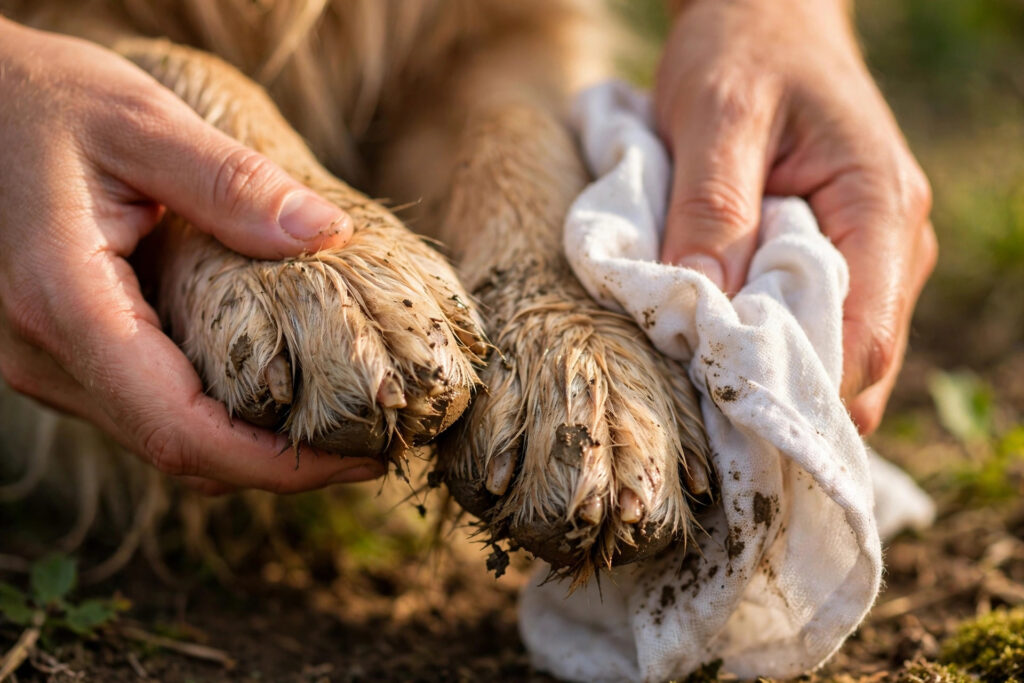
You know the moment. You get back from a walk, your dog’s paws are black with city grime, and there’s a pump bottle of antibacterial soap right there by the sink. It kills 99.9% of germs on your hands — surely it’s the responsible choice for paws too?
That’s exactly the logic behind most searches for antibacterial soap for dogs paws. And it’s wrong in a way that’s easy to miss, because the soap does kill germs. The trouble is what it does to everything else.
Your Skin and Their Paws Play by Different Rules
Human skin sits around pH 5.5 — mildly acidic. A dog’s skin runs closer to 7 or 7.5, nearly neutral. Soap makers formulate for the customer, and you’re the customer, not your dog.
Use that soap on paws regularly and it throws the skin’s balance off. Natural oils get stripped. Pads dry out, then crack, then itch. And here’s the part nobody warns you about: itchy paws get licked. Obsessively. All that saliva traps moisture between the toes, and warm, damp skin is prime real estate for yeast and bacteria. The germs were never the issue with antibacterial soap for dogs paws — the formula is. The soap you bought to prevent trouble can set the stage for a genuine infection. If the licking has already started, this piece on why dogs lick their paws covers the other usual suspects too.
Now — does a dog version of antibacterial soap for dogs paws exist? Sort of. Vets can prescribe medicated antibacterial washes, but those are treatments, not toiletries. There’s no everyday middle ground, because a healthy dog doesn’t need one. That’s the uncomfortable truth behind the antibacterial soap for dogs paws trend: the product doesn’t exist because the need doesn’t exist.
What Vets Actually Reach For
When a vet wants to disinfect dog skin, the bottle they grab contains chlorhexidine — usually at 2 to 4%. It kills bacteria, and paired with an antifungal it handles yeast as well. You’ll find it as wipes, shampoos, and sprays.
Three reasons it’s the standard: it works without being harsh, it keeps working after you’ve applied it, and unlike alcohol it doesn’t sting or wreck the skin’s moisture barrier. The drugstore aisle’s answer to antibacterial soap for dogs paws and your vet’s answer are two different things.
But keep the context straight. Chlorhexidine is medicine, not maintenance. Vets recommend it for specific problems — yeast building up between the toes, mild bacterial irritation, a skin issue they’ve actually flagged. If there’s one legitimate version of antibacterial soap for dogs paws, it’s a chlorhexidine wash your vet prescribed for a reason. Nobody at the clinic is telling you to buy it “just in case.” If your vet hasn’t mentioned it, you don’t need it.
And one boundary people get wrong: don’t put antiseptics on open wounds or deep cuts on your own say-so — chlorhexidine included. A cut that looks shallow can be deeper than it appears, and damaged tissue plus antiseptic isn’t always a friendly combination.
The Two-Minute Routine That Actually Works
Forget the medicine cabinet. Here’s the whole routine: lukewarm water, a dog-safe shampoo (or pet wipes when you’re in a hurry), and a towel. Two minutes, tops.
Rinse or wipe each paw after walks, getting between the toes where grit hides. Small amount of shampoo if you use it, then rinse it fully out — leftover residue irritates skin just like the wrong soap does.
Then dry. Properly. This is the step everyone skips, and honestly it’s the most important one. Dampness between the toes invites exactly the yeast and bacteria you’re trying to avoid — that faint corn-chip smell is often the first hint things are tipping out of balance. Pat each paw, get between the pads, done.
How often? Match it to the dirt. Daily walks on grimy sidewalks — wipe every time. Mostly-indoor dog in a clean neighborhood — a few times a week is plenty. Washing more often doesn’t mean upgrading to antibacterial soap for dogs paws. It just means more rinsing.
Never Use These on Paws
Hand sanitizer. Not a gray area. The FDA has warned pet owners outright: keep it off your dog. Alcohol can absorb through skin, and dogs will lick it off — that’s alcohol poisoning territory. It also dries and cracks pads, and cracked pads let everything in. When someone searches antibacterial soap for dogs paws, hand sanitizer is often the next thing they grab. Don’t. If your dog gets into sanitizer, call your vet or the Pet Poison Helpline at (855) 764-7661 immediately.
Rubbing alcohol and alcohol wipes. Same family, same damage — stripped moisture barrier, slow healing. Dogs hate the smell for good reason.
Bleach, detergents, household cleaners. Made for countertops, not living tissue. Even watered down, they can burn paw pads. And whatever’s on the paws ends up in the mouth.
Human antibacterial soap. Wrong pH, strips oils, dries and irritates with repeated use. One accidental rinse won’t cause lasting harm — rinse well with plain water and move on. Just don’t make it a habit.
Dawn dish soap. You will see this one recommended all over the internet, usually with the oil-spill wildlife rescue story attached. And yes, it is great at cutting grease — that is exactly the problem. It strips the natural oils out of your dog’s skin and paw pads, and used regularly it leaves them dry, itchy, and cracked. Once in a real pinch, well diluted and rinsed off properly, it will not hurt. But it was never made for routine paw washing, and your dog’s paws will tell you that pretty quickly.
When to Skip Home Care and Call the Vet
Cleaning handles dirt. It doesn’t handle damage. Call the vet instead of reaching for the tap if you see:
- Bleeding that won’t stop with a few minutes of gentle pressure
- Anything deeper than a surface scrape, or any puncture at all
- Swelling, heat, or pus between the toes
- Limping that doesn’t ease up after a short rest
- A torn or half-detached nail
- Something stuck in the pad — glass, a thorn, a foxtail — that won’t come out easily
Light surface scrapes, the kind with no real bleeding? Lukewarm water, keep an eye on it. But no antibacterial soap for dogs paws will fix a puncture or stop real bleeding. Punctures are the sneaky ones — tiny on the surface, trapping bacteria deep underneath. When you’re unsure, the vet visit costs less than the infection.
FAQs
I used antibacterial soap for dogs paws once — should I panic?
No. A single wash won’t cause lasting damage. Rinse the paws well with plain water to get the residue off, and switch to a dog-safe option from here on. It’s repeated use that causes the dryness and irritation, not one accident.
Is there a dog-safe antibacterial soap for dogs paws worth buying?
There are vet-formulated antibacterial washes, usually chlorhexidine-based — but they’re medicated products for specific skin issues, not everyday cleansers. Unless your vet recommended one, save your money. Water and dog shampoo do the daily job.
Why do my dog’s paws smell like corn chips?
That’s yeast and bacteria — paws naturally host some, and a faint smell is normal. When it gets strong, or the licking turns constant, it can mean overgrowth worth a vet visit. Clean, dry paws keep it in check.
Are pet wipes enough for everyday cleaning?
Most days, yes. A decent pet wipe after walks handles surface dirt. Save the full rinse-and-dry for muddy days or grit stuck between toes. One check: make sure they’re actually pet-formulated. Baby wipes often contain fragrances that irritate dog skin.
So the short version: antibacterial soap for dogs paws sounds like the careful choice, but the human kind causes the very problems you’re trying to avoid. Warm water, dog-safe shampoo, towel dry. That’s the entire routine — and it’s enough.