
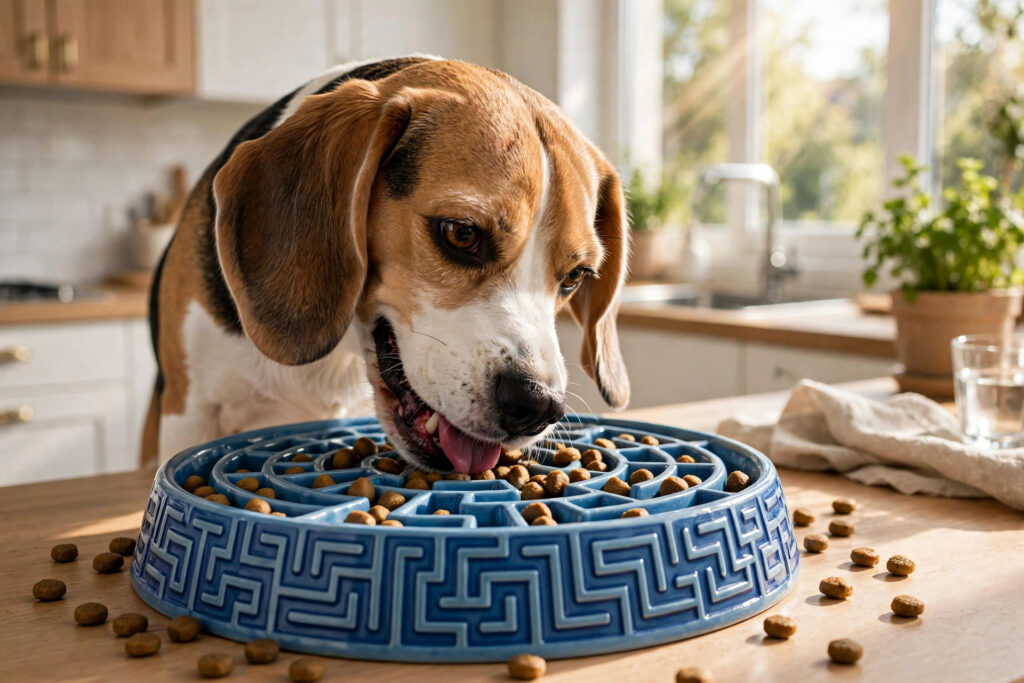
You know the sound. That frantic scarf-scarf-scarf from the kitchen corner — and before you’ve even sat down with your own plate, it’s over. Twenty seconds. Bowl licked clean. And then the look. The pacing. Sometimes the retching at 2 a.m. that has you googling “dog ate too fast vomiting” with one eye open.
If that’s your nightly routine, you’re not alone — and you’re not doing anything wrong. Some dogs are just wired to inhale. But here’s what most gulping-dog owners don’t find out until a vet mentions it: eating that fast isn’t just messy. It can mean regular vomiting, painful gas, the occasional choking scare — and in deep-chested breeds, it raises the risk of bloat, which is genuinely dangerous.
The fix is beautifully simple. A slow feeder dog bowl looks like an ordinary bowl with a maze molded into the bottom. Same food, same spot on the floor — but now your dog has to work around the ridges, and those 20 seconds stretch into five or ten minutes. Less air swallowed. Better digestion. A calmer dog after dinner.
We dug through the current expert roundups and tens of thousands of owner reviews to find the best slow feeder dog bowls worth your money right now — not last year’s leftovers. Here are the five that kept rising to the top.
Which Slow Feeder Dog Bowl for YOUR Dog? Start Here
Don’t want the full deep-dive? This is the shortcut:
- Want the safe default most owners buy? → Outward Hound Fun Feeder, our #1 pick.
- Two dogs, or want a spare on hand? → MateeyLife 2-pack, #2.
- Not sure your dog will even tolerate a maze? → UPSKY — the under-$10 trial, #3.
- Your dog has already defeated simpler bowls? → JASGOOD spiral, #4, the toughest maze here.
- You refuse to feed from plastic? → LE TAUCI ceramic, #5, the premium upgrade.
Now the full story — including the one thing about bloat nobody tells you straight.
Why Your Dog Needs This
Fast eating causes a chain reaction most owners never connect. Gulping means swallowing air along with the food, and that air has to go somewhere — usually back up. That’s the vomiting and the room-clearing gas. It also means food hits the stomach barely chewed, which makes digestion harder work than it needs to be. And every speed-eater has had at least one choking scare that took a year off your life. A slow feeder dog bowl breaks that chain at the very first link.
Then there’s bloat. Let me be straight with you, because most articles won’t be: no slow feeder dog bowl can promise to prevent bloat. Gastric dilatation-volvulus — the stomach flipping — is complicated, and genetics and anatomy play huge roles, especially in deep-chested breeds like Great Danes, German Shepherds, and Standard Poodles. Anyone selling you a bowl as “bloat-proof” is overselling.
What the evidence does suggest is more modest and still worth having: eating slower means less air gulped and a less frantic stomach, which removes one piece of the risk puzzle. Think of the best slow feeder dog bowls as one sensible layer of protection — alongside not exercising right after meals and knowing bloat’s warning signs — not a guarantee.
There’s a bonus nobody talks about enough, too. Working through a maze turns dinner into a puzzle — and the best slow feeder dog bowls double as enrichment toys. For bored, smart, high-energy dogs, those extra minutes of problem-solving are genuine mental stimulation — the kind that can take the edge off evening zoomies. And slower eaters tend to actually feel full, which helps the dogs who’d otherwise convince you they’re starving an hour later.
Quick Comparison Table
Here’s how the five best slow feeder dog bowls compare at a glance — detailed reviews follow below.
| Pick | Best For | Material | Dishwasher Safe | Price |
|---|---|---|---|---|
| Outward Hound Fun Feeder (#1) | Most fast eaters — the default choice | BPA-free plastic | Yes, top rack | Budget |
| MateeyLife 2-Pack (#2) | Multi-dog homes, backup bowl | BPA-free polypropylene | Yes | Budget |
| UPSKY (#3) | First-timers, puppies 12+ weeks | Food-safe plastic | Yes | Cheapest |
| JASGOOD Spiral (#4) | Extreme gulpers who beat easy mazes | High-strength PP | Yes, top rack | Budget |
| LE TAUCI Ceramic (#5) | Plastic-free homes, chewers | Glazed ceramic | Yes + microwave safe | Mid-premium |
Disclosure: As an Amazon Associate I earn from qualifying purchases, at no extra cost to you. This helps support TheDogsUSA and allows us to keep creating helpful dog guides.
Top 5 Best Slow Feeder Dog Bowls
1. Outward Hound Fun Feeder Slo Bowl — Best Overall
If you only remember one name from this list, make it this one. The Fun Feeder is the slow feeder dog bowl that basically invented the category, and it’s still the one every expert roundup puts at #1 — with well over a hundred thousand owner reviews backing that up. The reason is simple: it gets the fundamentals right. Multiple maze patterns in three difficulty levels, so you can start easy and level up. Sizes from tiny to large (2-cup and 4-cup), so it actually fits your dog instead of the other way around. Food-safe plastic with no BPA, PVC, lead, or phthalates. Top-rack dishwasher safe. Non-skid base so it doesn’t go skating across the kitchen.
What owners love most is that it just works without drama. Dogs figure out the maze quickly but still eat dramatically slower, and the patterns are deep enough to matter without being so hard that dogs give up and flip the bowl — the classic failure mode of cheap maze bowls.
Pros:
- Widest range of sizes and maze difficulties — fits almost any dog
- Enormous review base; consistently top-rated year after year
- Dishwasher safe and genuinely non-slip
- Budget-friendly price for the quality
Cons:
- Plastic — not for power chewers who gnaw bowls
- Determined genius dogs may eventually solve the easier patterns (that’s what the harder ones are for)
Check the latest price on Amazon
2. MateeyLife Slow Feeder Dog Bowls (2-Pack) — Best Value
Two bowls for roughly the price of one premium bowl. That’s the whole pitch, and honestly, it’s a good one. The MateeyLife 2-pack gives you two 2-cup maze bowls in food-safe, BPA-free polypropylene, both dishwasher safe with a widened non-slip base. They handle dry kibble, wet food, and raw diets equally well — the maze channels are shaped to work with all three, which isn’t true of every slow feeder dog bowl out there.
The real use case is obvious: two dogs, or one dog plus a clean spare while the other is in the dishwasher. But even single-dog homes buy it as the “I don’t want to hand-wash a maze bowl every night” solution. Rotate and you’re done.
Pros:
- Two bowls for the price of one — unbeatable value
- Works with dry, wet, and raw food
- Dishwasher safe, solid non-slip base
Cons:
- Only one maze difficulty — extreme gulpers may outgrow it
- 2-cup capacity won’t suit giant breeds
Check the latest price on Amazon
3. UPSKY Slow Feeder Dog Bowl — Best Budget Trial
Not sure your dog will tolerate eating from a maze? Don’t overthink it — spend under ten dollars and find out. The UPSKY is the cheapest credible entry point into slow feeder dog bowls: food-safe plastic with bone-shaped raised ridges, a 1–2 cup capacity sized for small and medium dogs, dishwasher safe, and it comes with stick-on anti-slip mats for the base.
Is it the most challenging maze here? No. That’s the point. For puppies 12 weeks and up, or for a dog trying a maze bowl for the first time, you want gentle — a bowl so frustrating the dog quits is worse than no bowl at all. If your pup takes to it and starts inhaling again in a month, graduate to #1 or #4. Think of this as the low-stakes experiment.
Pros:
- Cheapest way to test whether your dog accepts maze bowls
- Gentle difficulty — great for puppies and beginners
- Dishwasher safe; anti-slip mats included
Cons:
- Too easy for committed gulpers — they’ll solve it fast
- Small capacity; not for large breeds
Check the latest price on Amazon
4. JASGOOD Slow Feeder Dog Bowl (Spiral) — Toughest Maze
Some dogs don’t just eat fast — they treat every bowl like a personal challenge. If yours has already breezed through a basic maze bowl and gone right back to inhaling, the JASGOOD spiral is the answer. The deep spiral channels are the most demanding pattern among the best slow feeder dog bowls in this price range, and they produce the longest eating times owners report — we’re talking genuinely slowed-down meals, not a thirty-second delay.
It’s built from high-strength, food-safe PP (no BPA, PVC, or phthalates), holds about 3 cups, and the 9.6-inch diameter gives big muzzles room to work. Top-rack dishwasher safe, widened base plus stick-on anti-slip mats so it stays put while your dog problem-solves. Multiple colors if you care about that sort of thing.
Pros:
- Deepest, most challenging maze in the budget range
- Generous 3-cup capacity suits medium and large dogs
- Stays put during enthusiastic eating
Cons:
- Overkill for mild fast eaters — and frustrating for puppies
- Deep channels need a proper scrub if you skip the dishwasher
Check the latest price on Amazon
5. LE TAUCI Ceramic Slow Feeder Dog Bowl — Best Non-Plastic Upgrade
Then there’s the plastic question. Some owners don’t want their dog eating from plastic every day — chewers who gnaw bowls into sharp bits, or anyone who’s dealt with the chin staining some dogs get from plastic (“black jaw” is a real thing vets mention). The LE TAUCI is the premium answer: a glazed ceramic slow feeder dog bowl that looks like something you’d actually want on your kitchen floor.
Ceramic changes the equation. It’s heavy — around a kilo — so it anchors itself without any stick-on pads to lose. It’s chew-proof in a way plastic never will be. It’s dishwasher AND microwave safe. It comes in 0.5, 1.5, and 3-cup sizes (the 1.5-cup is the sweet spot for most medium dogs). The maze is moderately challenging — not the toughest here, but absolutely enough to slow a normal gulper down. Yes, it costs two to three times the plastic options. For a bowl your dog uses twice a day for years, that math works out fine.
Pros:
- No plastic — ideal for chewers and hygiene-focused owners
- Heavy weighted base; nothing to stick on or lose
- Dishwasher and microwave safe; genuinely good-looking
Cons:
- Costs significantly more than plastic bowls
- Ceramic can chip or break if dropped on hard floors — and it’s not for the most extreme gulpers
Check the latest price on Amazon
Buying Guide: How to Choose
Material first. Plastic (including polypropylene) is light, cheap, and comes in the most maze designs — fine for most dogs. It’s no accident that most of the best slow feeder dog bowls are plastic: variety and price win. Ceramic costs more but wins on hygiene, weight, and chew-resistance. Stainless steel slow feeders exist too, though the maze options are thinner. If your dog chews bowls, skip plastic entirely.
Size it to the meal, not the dog. A slow feeder dog bowl should hold your dog’s actual meal with a little room to spare — too big and the maze effect weakens, too small and food piles over the ridges. Measure a typical meal in cups, then match the bowl’s capacity. Giant breeds need the 3–4 cup end of the range.
Match difficulty to the eater. This is where people go wrong when choosing among the best slow feeder dog bowls. A gentle maze for a first-timer or puppy; a deep spiral for the dog who’s already conquered a basic bowl. Too hard and the dog gets frustrated and flips it. Too easy and you’ve bought an expensive regular bowl.
Cleaning will make or break it. Even the best slow feeder dog bowls trap food in crevices — that’s literally their job. Dishwasher-safe isn’t a nice-to-have, it’s the difference between a bowl you use for years and one you abandon in a month. All five picks above are dishwasher safe for exactly this reason.
Stability matters. An excited dog + a sliding slow feeder dog bowl = kibble across the kitchen. Look for a non-slip base, a widened footprint, or enough weight to stay put. Ceramic wins here by default.
Flat-faced breeds need special shapes. Pugs, bulldogs, and other flat-faced dogs can struggle with deep, narrow maze channels — their muzzles physically can’t reach. Shallower, wider patterns work better for them. When in doubt, go easier, not harder.
Frequently Asked Questions
Do slow feeder dog bowls really work?
Yes — a good slow feeder dog bowl works dramatically for most dogs. The maze forces smaller bites and pauses, which typically stretches a 20-second inhale into several minutes. They won’t fix every fast eater (a truly determined dog can learn any maze), but for the average gulper the difference is immediate and obvious from the first meal.
Can puppies use slow feeder bowls?
Yes, from around 12 weeks, but start with a gentle maze. A puppy facing a brutally hard spiral will just get frustrated. The UPSKY (#3) is the natural starter — cheap, easy, and sized right. Level up as they grow.
Will a slow feeder stop my dog vomiting after meals?
Often, yes — fast-eating vomit is usually regurgitation from swallowed air and unchewed food, which is exactly what slower eating fixes. But if vomiting continues even with slow feeding, or you see lethargy, drooling, or a swollen belly, see your vet. Persistent vomiting is a vet conversation, not a bowl problem.
Are slow feeder bowls bad for dogs’ teeth?
There’s no good evidence that slow feeder dog bowls harm teeth — dogs lick and nudge around the ridges rather than chewing them. The exception is aggressive chewers who gnaw the bowl itself; for those dogs, choose ceramic (#5) and supervise meals.
How do I clean a slow feeder bowl?
Dishwasher, top rack, done — that’s why every pick on this list is dishwasher safe. Dried-on wet food cemented into maze channels is miserable to scrub by hand, so don’t buy a bowl you’d have to.
The Bottom Line
Your dog isn’t broken for eating fast — but you don’t have to live with the 2 a.m. retching either. For most owners, the Outward Hound Fun Feeder (#1) is the answer: proven, cheap, and sized for nearly every dog. On a tight budget or testing the waters, grab the UPSKY (#3). And if plastic’s a dealbreaker, the LE TAUCI ceramic (#5) is worth every extra penny.
Whatever you choose, That’s what the best slow feeder dog bowls deliver — calmer dinners, easier digestion, and one less thing to worry about at midnight. That’s a good trade.
—