
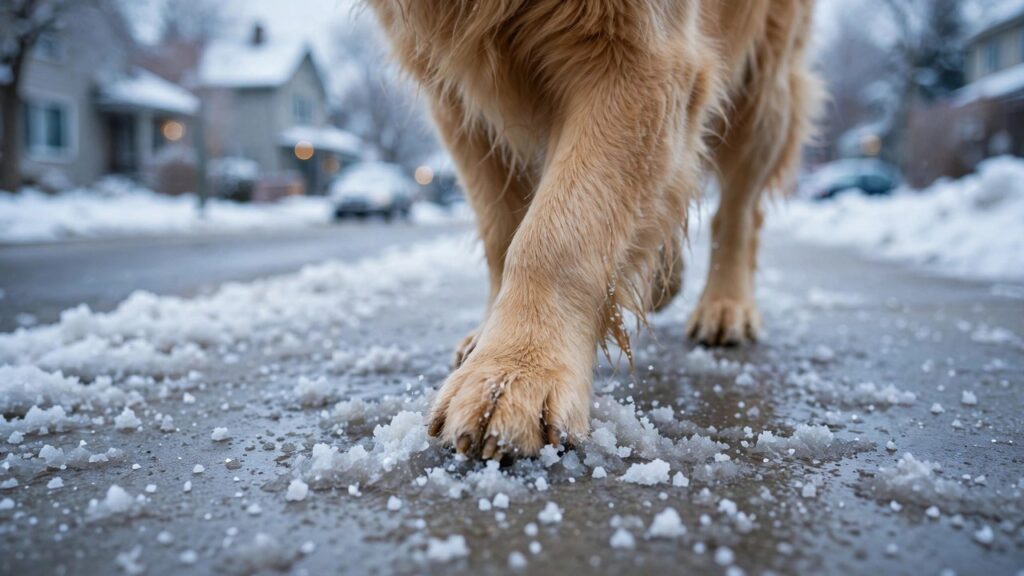
No ice melt is completely safe for dogs, but some are much safer than others, and the real risk depends on which chemical is on the sidewalk and how much of it your dog swallows. A dog that walks across rock salt and licks its paws at home is in a very different situation from a dog that eats a mouthful of pellets from a spilled bag. This guide ranks the risk the way a vet would: the bag first, then the licking, then the paw contact, and shows you how to read the label and run a simple before, during, and after walk routine.
What is actually on the sidewalk?
What is on the sidewalk is not one thing called salt. It is one of several chemicals, and each one behaves differently in the cold and on your dog’s paws. Rock salt is the cheapest and the most common on public sidewalks, which is why most dogs meet it first. The table below shows the practical melting floor for each one, meaning the coldest temperature where it still works. These are approximate thresholds from the City of Ann Arbor and the Minnesota Pollution Control Agency, and individual products vary.
| De-icer | Works down to about | What it does to paws |
|---|---|---|
| Sodium chloride (rock salt) | 15–20°F | Dries and irritates pads, the most common sidewalk salt |
| Calcium chloride | −20 to −25°F | Gives off heat as it dissolves, the harshest common melt on skin |
| Magnesium chloride | −10°F | Milder on skin than rock salt or calcium chloride |
| Potassium chloride | ~12°F | Slow, often blended into “pet-friendly” mixes |
| Calcium magnesium acetate (CMA) | ~20°F | Among the gentlest on paws and concrete, usually the priciest |
| Urea | 15–20°F | Slow, milder, often the base of pet-safe blends |
Two things matter here. First, below its floor a melt stops melting and just sits there as grit, so a bag of rock salt spread on a single-digit night is doing nothing except irritating paws. Second, the chemical on the bag matters more than the brand on the front. A jug that says “pet safe” can still be mostly rock salt with a little of something gentler mixed in. The ingredient list, and the product safety data sheet if you want the full picture, tells you what is really inside.
What does winter salt do to my dog’s paws?
Winter salt dries out your dog’s paw pads, irritates the skin between the toes, and in bad cases cracks or burns it. Salt crystals lodge between the pads, and every step grinds them in a little further. Cornell University warns that salt and other road de-icers can irritate paws, and the ASPCA notes that extended exposure causes skin irritation and cracked or bleeding pads. Calcium chloride is the worst of the common melts on skin because it gives off heat as it dissolves.
Check your dog’s paws while you dry them after every walk, and look for these signs:
- Red, dry, or cracked pads
- Limping or a sudden reluctance to keep walking
- Excessive licking or chewing at the paws
- Soreness or redness between the toes
Small dogs and short-haired dogs suffer first because they spend more time close to the ground and lose heat faster, and Cornell points to boots particularly for them on long winter walks. A dog that keeps licking its paws after you come inside is not just grooming. It is telling you something hurts, and it is also swallowing whatever was on those paws, which brings us to the bigger risk.
Is ice melt safe for dogs if they lick it or eat it?
Ice melt is not safe for dogs to eat, but a couple of licks off a paw is usually a small problem, while a mouthful from the bag is an emergency. The ASPCA’s veterinary toxicologists put it plainly: a couple of licks of a paw or treated ground will not cause serious problems, and the usual result is drooling, vomiting, or diarrhea that settles on its own. The danger grows with the amount.
Here is the triage, worst first:
The bag. A dog that gets into the container and eats pellets, or eats mouthfuls of heavily salted snow, is the most serious case. Large amounts of sodium, potassium, or magnesium chloride can bring dehydration, electrolyte problems, tremors, and seizures. Calcium chloride can ulcerate the mouth and stomach, badly enough that the dog stops eating and drinking. Call your vet or the ASPCA Animal Poison Control Center at (888) 426-4435 immediately.
A pile. A dog that licks up a small pile of pellets or a mouthful of treated slush needs watching. Expect drooling, vomiting, or diarrhea. If the vomiting is more than mild, or the dog shows any wobbliness or tremors, get to a vet clinic right away. Do not make your dog vomit unless a vet professional tells you to.
A lick. A dog that licks its paws after a normal walk has probably swallowed a small amount. Wipe or rinse the paws, offer fresh water, and watch for stomach upset over the next few hours. Most of the time this passes on its own, but if vomiting or diarrhea keeps going, call your vet.
One warning that matters: some de-icers contain ethylene glycol, the same chemical as antifreeze, which is poisonous. That is a separate emergency, covered below. And never trust a phone number printed on a random blog. The correct ASPCA Poison Control number is (888) 426-4435, and the Pet Poison Helpline is (855) 764-7661. Both are open on holidays, and a consultation fee may apply.
What does “pet safe” on the bag actually mean?
“Pet safe” on a bag of ice melt means almost nothing, because there is no agreed standard and no specific labeling rule behind those words. The ASPCA has said so directly: there are no labeling requirements for pet-safe de-icers. A product can call itself pet safe while still being mostly rock salt, and the gentler ingredient can be a small part of the blend.
Here is how to choose a melt for your own steps instead of trusting the front of the jug:
- Read the ingredient list first. The safest common choices are urea-based formulas, magnesium chloride, potassium chloride, and calcium magnesium acetate. The VCA names potassium chloride, magnesium chloride, and calcium magnesium acetate as the safer options.
- Remember that safer is not safe to eat. Even the gentler formulas can cause stomach upset if a dog eats enough of them. Gentle means gentle on feet, not edible.
- Check the safety data sheet. It lists the main ingredients and rough percentages, and it is the fastest way to see what is really in a blend.
- Use less than you think. Spread thin, and sweep up the leftover pellets once the ice is gone. The excess is what dogs walk through and lick up.
- Sand is the zero-chemistry option. Plain sand or small-grain gravel does not melt ice at all, but it gives traction at any temperature, and for a path your dog uses every day, that can be the simplest answer.
If you share a sidewalk with neighbours, you cannot control what they spread. That is why the walk routine below matters more than the bag you buy.
How do I protect my dog’s paws in winter?
You protect your dog’s paws in winter with a short routine before, during, and after every walk, not with one product. Washing paws after the walk is the single most important step, and Cornell and the University of Wisconsin both advise it, but it works best as part of a system.
Before the walk. Trim the fur between the paw pads so snow cannot ball up there. A thin layer of paw balm or wax conditions the skin and keeps it supple, which helps against salt contact. Use a balm made for dogs, not human foot cream, and skip anything with xylitol or tea tree oil. Put the balm on clean, dry paws, never on top of salt residue, because that seals the salt in.
During the walk. Steer around visible piles of winter salt and the white crusty patches on the sidewalk. Keep walks shorter on the coldest days, and watch for the moment your dog starts lifting its paws or limping. That is the signal to head home.
After the walk. Rinse or wipe the paws with lukewarm water, never hot, after every walk, then dry them thoroughly, especially between the toes. Check for cracked pads and redness while you dry. This one habit costs two minutes and does more than any single product.
Now the honest part about balm versus boots. Paw balm soothes and conditions the skin, and it reduces salt contact, but it does not reliably stop salt reaching the paw. Boots are the only option that blocks salt, cold ground, sharp ice, and chemicals at the same time. If your dog hates boots, that is normal. Condition them at home across several short, cheerful sessions until your dog moves normally, and never force a first walk in boots on a salted sidewalk. Sudden use can change how a dog walks and cause distress. Our roundup of waterproof boots for dogs covers the styles that hold up in slush, and our winter care guide covers the rest of the cold-weather routine.
What about antifreeze?
Antifreeze is a separate emergency, and it is far more dangerous than any ice melt. The ASPCA calls ethylene glycol highly toxic, and a small amount can be potentially fatal. Dogs are drawn to its sweet taste, and it pools in driveways and parking lots where cars leak it. If you even suspect your dog licked antifreeze, go to a vet hospital right away, even if your dog seems fine. Do not wait for symptoms. Some de-icers also contain ethylene glycol, which is one more reason to read the ingredient list on the bag, not just the front.
For paws that are already dry or cracked from winter walks, our coconut oil for dog paws guide covers aftercare in detail. And if you decorate for the holidays, our Christmas plants guide includes the salt-dough ornament warning, which is the same salt in a different shape.
FAQ
Can dogs walk on salted sidewalks?
Yes, but keep it short and rinse their paws with lukewarm water as soon as you get home. Winter salt dries and irritates paw pads, and crystals lodge between the toes. If your dog starts limping or lifting its paws, head home right away.
How do I clean salt off my dog’s paws?
Rinse or wipe the paws with lukewarm water after every walk, then dry them thoroughly, especially between the toes. Check for cracked pads and redness while you dry. Do not use hot water, and do not put balm on paws that still have salt on them.
Is calcium chloride ice melt safe for dogs?
Calcium chloride is the harshest common ice melt on skin because it gives off heat as it dissolves, and if a dog eats a large amount it can ulcerate the mouth and stomach. It works in the coldest weather, down to about −20 to −25°F, but for a home with dogs, magnesium chloride or a urea-based melt is a gentler choice.
What is the safest ice melt for dogs?
The gentlest options are urea-based formulas, magnesium chloride, potassium chloride, and calcium magnesium acetate (CMA). None of them is safe to eat, and “pet safe” on the label has no agreed standard, so read the ingredient list and use the smallest amount that does the job.
My dog ate ice melt. What should I do?
Call your vet or the ASPCA Animal Poison Control Center at (888) 426-4435 right away, and tell them how much your dog ate and which product it was. Do not make your dog vomit unless a vet professional tells you to. A couple of licks usually means mild stomach upset, but a mouthful from the bag, vomiting that will not stop, or any tremors or wobbliness needs a vet visit immediately.