
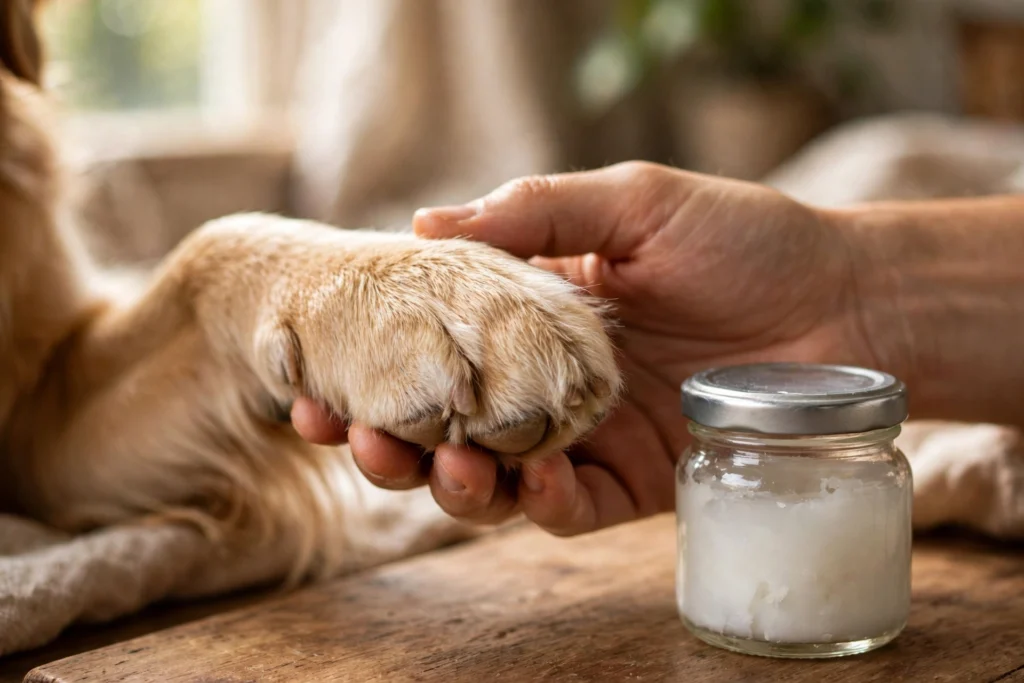
You know the look. It’s February, the sidewalks are white with road salt, and your dog’s paw pads feel like dried riverbed — rough, a little flaky, catching on the blanket. Then you remember the jar of coconut oil in the kitchen. People swear by coconut oil for dog paws. The internet is full of it. But is it actually helping, or are you just making your dog’s feet greasy for no reason?
Fair question. Here’s the honest version.
What Coconut Oil for Dog Paws Actually Does
First, the boring-but-important part: coconut oil is an emollient. That’s a fancy word for “softens and coats.” A thin film on mildly dry pads takes away that tight, dry feeling and makes the surface smoother. That’s the main thing coconut oil for dog paws does, and for simple dryness, it’s enough.
Then there’s the part that made scientists interested. About half the fat in coconut oil is lauric acid, and lab studies have shown it can damage bacterial cell walls — including Staphylococcus aureus, a bacterium that shows up in dog skin trouble. That’s real research, not marketing.
But — and this matters — a petri dish isn’t a paw. The studies tested specific concentrations in labs, not a smear of kitchen oil on a living dog. So coconut oil for dog paws has genuine antimicrobial potential, which is more than you can say for most pantry remedies. It is not, however, an antibiotic. Don’t let anyone tell you different.
What it can’t do is just as important:
- It won’t heal deep cracks, especially ones that bleed.
- It won’t cure a yeast or bacterial infection between the toes.
- It won’t stop licking that’s driven by allergies — it’ll just get licked off.
- It won’t fix a burn, a cut, or anything stuck in the pad.
Think of coconut oil for dog paws as moisturizer with a bonus, not treatment. If the paw problem has a cause — infection, allergy, injury — the oil is just decorating the symptom.
When It’s Worth Trying (and When to Skip It)
Coconut oil for dog paws makes sense as a short home trial when the pads are mildly dry or rough but intact — no bleeding, no deep splits, dog walking normally, no heat or swelling. Classic triggers for reaching for coconut oil for dog paws: winter air and road salt, summer hot pavement, or just a lot of miles on rough ground.
Skip the jar and call the vet instead if you see any of these:
- Bleeding, deep cracks, or a puncture
- Swelling, heat, discharge, or a strong yeasty smell between the toes
- Limping or obvious pain
- Redness that’s spreading rather than fading
- Constant licking or chewing that doesn’t let up
- Anything stuck in the pad that won’t come out easily
One sore paw usually means something local — a cut, a thorn, a burn. All four paws acting up usually means something bigger — allergies, irritation, environment. Coconut oil for dog paws doesn’t change that math. It just buys comfort for the mild stuff while you watch.
How to Apply It the Right Way
The method matters more than the product. Here’s the whole routine:
1. Look before you coat. Check every pad and between every toe. Never put oil over a cut, burn, puncture, bleeding crack, or anything oozing. Oil seals things in — including infection.
2. Clean and dry first. Rinse off salt, dirt, and whatever the sidewalk contributed, then dry thoroughly — especially between the toes. Oil on top of grime just traps the grime.
3. Use less than you think. Scoop a pea-sized amount of plain virgin coconut oil, warm it between your fingers until it melts, and massage a thin film into the pads. If the paw looks visibly greasy, you’ve used too much. Thin is the whole game with coconut oil for dog paws.
4. Handle the licking. Most dogs will try. A brief distraction works better than a battle — apply it right before a walk (movement + time to absorb), or follow with a chew toy. Some people slip a baby sock over the paw for 10 minutes. Whatever works, as long as the oil gets a few minutes to settle.
5. Reassess, don’t just repeat. Once a day for a few days is plenty for mild dryness. If the pads look better, taper off. If they’re getting redder, wetter, or smellier — or the licking ramps up — stop and figure out the cause instead of adding more oil.
Will He Get Sick From Licking It?
Probably not from a normal application. A few licks of a thin layer of coconut oil for dog paws is a tiny amount of fat — most dogs won’t notice it digestively. The ASPCA’s stance on coconut products is reassuring in small quantities.
The trouble starts when a dog goes to town: repeated licking, or getting into the jar itself. Then you’re looking at the usual too-much-fat fallout — soft stool, diarrhea, maybe vomiting. Wipe off the excess, put the jar away, and watch him.
One group deserves extra caution: dogs with a history of pancreatitis or other fat-triggered digestive issues. Coconut oil is concentrated fat, and for those dogs even repeated small licks deserve a vet’s opinion first. A single tiny taste isn’t an emergency — but don’t make it a habit without asking.
If the licking itself is the main event — constant, obsessive, focused on the paws — that’s worth reading about on its own. This piece on why dogs lick their paws covers what’s usually behind it, because coconut oil for dog paws won’t fix that part.
Coconut Oil vs Paw Balm: Which One Wins?
Honest answer? Depends on the job.
Coconut oil wins for light, everyday dryness. It’s already in your kitchen, it’s simple, and a thin layer is all mild pads need. This is the 80% case for coconut oil for dog paws.
Wax-based paw balm wins when the environment is brutal — daily walks on salted winter sidewalks, ice, or scorching summer pavement. Wax actually forms a barrier; oil mostly moisturizes. If you’re dealing with road salt every single day from December to March, a balm earns its keep.
They’re not enemies. Plenty of people use oil for mild days and switch to balm when winter gets serious. Match the product to the problem.
Which Jar From Your Kitchen?
Keep it simple: plain, virgin (unrefined) coconut oil, single ingredient. That’s the one with the most beneficial compounds intact, and the short label means you know exactly what touched the skin — and what got licked.
Refined coconut oil isn’t dangerous, but the refining strips out some of the good stuff you’re using it for. And skip anything with added fragrance, essential oils, or flavorings — those belong in candles, not on paws.
Stored at room temperature it’ll go solid below about 76°F and liquid above it. Both forms work exactly the same — just melt a dab between your fingers either way.
FAQs
Can I use the coconut oil I cook with on my dog’s paws?
If it’s plain virgin coconut oil with nothing added — yes, that’s exactly the right kind of coconut oil for dog paws. Check the label: one ingredient. If it’s a cooking spray or a blend with other oils or flavors, get a plain jar instead.
How often should I put coconut oil on my dog’s paws?
For mild dryness, once a day for a few days, then stop and see. It’s not a forever routine — healthy pads maintain themselves. If you find yourself reaching for it constantly, something else is going on and it’s worth a vet visit.
My dog licks it straight off. Now what?
Apply less, distract more. Right before a walk or with a chew toy works for most dogs. If he still won’t leave it alone, the licking itself might be the real issue — constant paw licking often points to allergies or irritation, not dryness.
Is coconut oil safe for puppies’ paws?
A thin layer on intact puppy pads is fine, same rules as adults. Puppies are world-class lickers though, so use even less and supervise. And anything beyond mild dryness in a puppy is worth a vet call sooner rather than later.
Can coconut oil replace a vet visit for cracked paws?
No. Mild surface dryness — sure, try it for a few days. Cracks that bleed, swelling, smell, limping, or anything that isn’t improving — that’s vet territory. Coconut oil for dog paws is home care, not healthcare.
So the short version: coconut oil for dog paws is a solid little home remedy for the mild stuff — dry, rough pads, nothing dramatic. Thin layer, clean paws first, watch the licking, and know when the jar isn’t the answer. That’s the whole trick.