
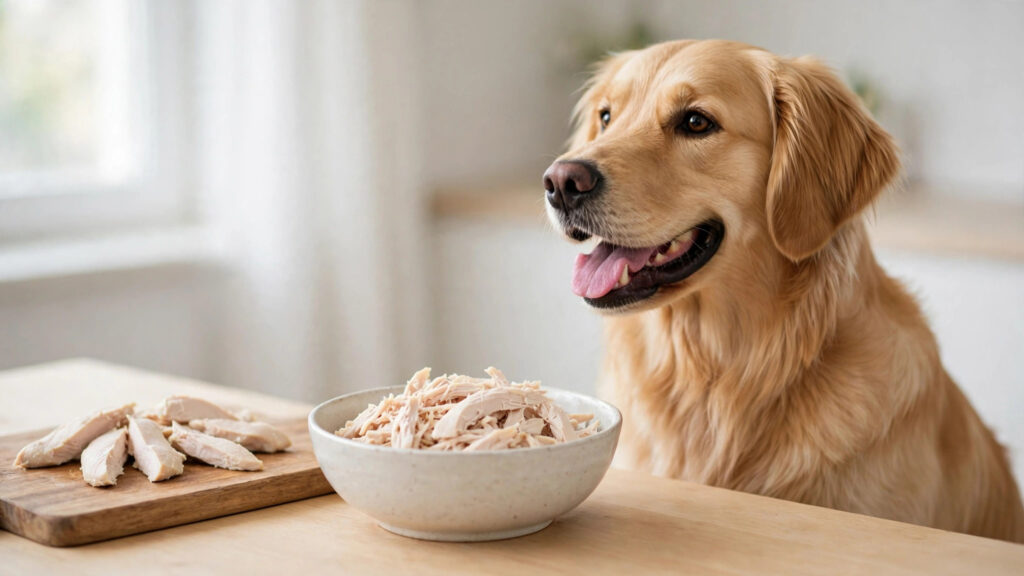
Yes — dogs can eat chicken, as long as it’s plain, boneless, skinless, and cooked all the way through.
That’s the short answer to can dogs eat chicken, and it’s one vets give without hesitation. Plain cooked chicken is one of the easiest proteins a dog can digest, which is exactly why vets reach for it when a stomach is upset. The catch is everything that usually comes with chicken in a human kitchen — the skin, the bones, the salt, the sauce, the crispy coating. Strip all of that away and you’ve got a genuinely good treat. Leave any of it on and you’ve got a vet visit waiting to happen.
So can dogs eat chicken off your dinner plate? Only if your plate looks nothing like a normal dinner plate. No seasoning, no skin, no bones, no sauce. Cook a plain piece just for them and it’s one of the simplest wins in dog feeding.
Key takeaways
- Yes, dogs can eat chicken — plain, boneless, skinless, and cooked to 165°F inside.
- Never feed cooked chicken bones: they splinter and can choke, block, or puncture the gut.
- Keep chicken inside the 10% treat rule — about 1/4 to 1/3 cup of cooked chicken per 20 lbs of body weight per day as a topper.
- Plain chicken breast has about 165 calories and 31 grams of protein per 100 grams — lean, but the calories still count in a small dog.
- Skip skin, fat, salt, garlic, onion, sauces, and fried or rotisserie coatings. Plain means plain.
- Chicken is also a common food allergy in dogs, so a first feed needs a watch-for-itching note — and dogs with pancreatitis or on a prescription diet should skip it unless the vet says otherwise.
Is chicken good for dogs?
Ask a vet can dogs eat chicken and you’ll usually get a yes before you’ve finished the question. The American Kennel Club says cooked chicken can be mixed into a dog’s regular meal as a good protein source, and PetMD describes it the same way — a lean protein that works on its own, stirred into meals, or as a treat. The reason is simple: plain chicken breast is mostly protein with very little fat, and dogs digest it easily. A 100-gram serving of cooked, skinless chicken breast runs about 165 calories and 31 grams of protein. That’s a solid little bundle for a treat.
But chicken is a supplement, not a meal. On its own it lacks calcium, several vitamins, and the mineral balance a dog needs long-term. Their kibble is already complete; the chicken is the bonus on top. If chicken starts replacing their regular food instead of topping it, they’re quietly losing nutrition while you think you’re feeding them better.
What’s actually dangerous — the bones
Here’s the part that matters most, and it’s not the meat at all. Cooked chicken bones are the real danger, and they’re far more dangerous than most owners realise.
Cooking makes bones brittle. A cooked chicken bone can splinter into sharp pieces that choke a dog, block the gut, or puncture the stomach or intestines. The AKC’s guidance is blunt: if your dog grabs a cooked bone, call your vet rather than wait and hope. PetMD says the same — never try to make your dog vomit after swallowing a bone, because that can cause more damage on the way back up. Call the vet, watch the stools for about 72 hours, and look for vomiting, straining, lethargy, or blood.
Raw bones are a different argument — some raw-feeding guides say they’re softer and less likely to splinter — but raw chicken carries salmonella and campylobacter, and the bacteria risk lands on your dog and everyone in the house who cleans up after them. The AVMA, the WSAVA, and the FDA all advise against feeding raw meat to pets. So the rule stays simple: meat yes, bones never, cooked or raw, and raw meat isn’t a default either.
Can dogs eat raw chicken?
No — and this one deserves its own answer, because raw feeding is all over the internet right now. Raw chicken often carries salmonella and campylobacter, bacteria that can make your dog seriously ill with vomiting, diarrhea, and fever. There’s a second risk people forget: a dog shedding salmonella in their stool can pass it to you, your kids, or anyone cleaning the yard.
Cooking chicken to 165°F (74°C) all the way through kills those bacteria for both of you. There’s no upside to raw chicken that cooked chicken doesn’t already give you, and the downside is a sick dog plus a sick household. Boil it, bake it, or poach it — and make sure there’s no pink left in the middle.
How much chicken can my dog have?
This is where most articles online trip over themselves, because they mix up three different jobs — a topper, a bland diet, and a main protein — and give one number for all three. The numbers below separate them, and they all sit inside the same rule: treats and toppers together stay under 10% of your dog’s daily calories.
As a topper or treat, PetMD’s guide is about 1/4 to 1/3 cup of cooked chicken per 20 lbs of body weight per day. In real portions, that works out like this:
| Dog size | Example breeds | Portion per day |
|---|---|---|
| Extra-small (under 10 lbs) | Chihuahua, Yorkie | 1–2 tablespoons, shredded |
| Small (10–25 lbs) | Beagle, Dachshund | about 1/4 cup |
| Medium (25–60 lbs) | Border Collie, Cocker Spaniel | 1/4 to 1/2 cup |
| Large (60–100 lbs) | Labrador, Golden Retriever | 1/2 to 3/4 cup |
| Extra-large (100+ lbs) | Great Dane, Mastiff | up to 1 cup |
That table is for chicken on top of their normal food. If chicken replaces a meal — the bland-diet case below — the amounts are bigger, because then it’s the meal, not the extra. And if you’re feeding chicken as the main protein in a homemade diet, the numbers climb again — roughly 20–30 grams of cooked chicken per kilogram of body weight per day — but that only works inside a professionally balanced homemade diet, with calcium and vitamins added in. Chicken alone, every day, as the whole diet, leaves a dog short on nutrients. Don’t improvise that one; build it with a vet or a veterinary nutritionist.
First time? Give a small taste and wait a day. If their stomach stays calm and their poop looks normal, move up to the portion above. And cut back the kibble a little on chicken days — the topper goes in the 10% budget, not on top of a full bowl.
The bland-diet recipe vets actually use
If your vet has ever told you to feed “chicken and rice” after a bout of diarrhea or vomiting, this is the recipe they meant — and it’s short-term, not a permanent diet.
Boil boneless, skinless chicken breast in plain water until it’s cooked through, then shred it. Cook plain white rice separately, no salt, no butter, no broth cubes. Mix them two parts rice to one part chicken. Feed small meals, three or four times a day instead of two big ones, at roughly 1 cup of the mixture per 20 lbs of body weight per day. A 20-lb Beagle gets about a cup a day, split up; a 60-lb Lab gets about three cups.
Keep it going for a few days, until the stomach settles, then switch back to their normal food gradually over two or three days — a little kibble mixed in, more each day. If the diarrhea lasts more than a day or two, or there’s blood, vomiting that won’t stop, or a dog that won’t drink, that’s a vet call, not a longer bland diet. And never put a dog on chicken and rice for weeks without vet guidance — it’s deliberately incomplete, which is fine for a few days and a real problem for a month.
How do I cook chicken for my dog?
Boiled is the easiest and the safest. Drop boneless, skinless breast into plain water, simmer 12–15 minutes until there’s no pink left in the middle and the inside reads 165°F, then cool and shred. No oil, no salt, no seasoning in the water — it doesn’t need it, and your dog won’t miss it.
Baked works too — plain breast on a tray, no oil, no marinade, cooked through. Poached is the same idea in a smaller pot. Grilled is fine as long as nothing was brushed on it and the outside isn’t charred and fatty.
Now the kitchen traps — the things that sneak into “plain” chicken in a real kitchen:
- Skin and fat. The skin is where most of the fat lives, and a fatty meal can trigger an upset stomach or, in sensitive dogs, pancreatitis. Peel it off before you serve.
- Salt and seasoning. Dogs don’t need it, and seasoning blends often hide garlic or onion powder. Both are toxic to dogs, in every form — raw, cooked, or powdered.
- Sauces and marinades. BBQ sauce, soy sauce, curry paste, tikka masala, biryani spices — all out. Onion, garlic, spices, and fat in one spoonful. The plain chicken underneath is fine; the sauce is the problem.
- Fried and breaded coatings. Nuggets, fried chicken, breaded strips — the coating is fat, salt, and seasoning, and the skin is usually still under it. Skip them.
- Rotisserie chicken. This is the trap most owners fall into, because it looks like plain chicken. It isn’t. The skin is salty and fatty, the meat under it has been basted in its own fat and seasoning, and the carcass is full of small cooked bones. If you want to share rotisserie chicken, pull off plain breast meat from the inside, no skin, and check twice for bones — or just cook a plain piece instead.
- Chicken bones in stock and broth. Store-bought broth usually has onion, garlic, and salt in it, and homemade stock made from bones can carry tiny bone fragments. If you want broth for your dog, make a plain batch — chicken and water only — or check the label like your dog’s stomach depends on it, because it does.
Easy ways to serve chicken to your dog
Once you’ve answered can dogs eat chicken with a yes in your own kitchen, here are the servings dogs actually get excited about:
- Shredded topper. A spoonful of shredded boiled chicken over their regular kibble. The smell alone usually gets a tail going, and it sits nicely next to other safe foods — our apples guide and bananas guide cover two more easy ones.
- Training-treat shreds. Tear cooked chicken into pea-size bits for training sessions. High-value, low-effort, and they pair well with the ideas in our guide to the best training treats for dogs.
- Lick-mat mash. Mash shredded chicken with a little plain pumpkin purée and smear it on a lick mat — slow, calming, and great for a dog who inhales food.
- Stuffed Kong. Pack shredded chicken into a Kong with a smear of plain pumpkin, freeze it, and hand it over when you leave the house.
- Bland-diet bowl. The chicken-and-rice mix above, served warm in small meals while a stomach recovers.
- Veggie bowl topper. A little shredded chicken over plain steamed carrots or green beans turns a boring bowl into dinner. And if you’re cooking a holiday meal, the same plain-chicken rule applies — our Thanksgiving foods guide covers what’s safe on the table and what isn’t.
Cooked chicken keeps in the fridge for three to four days. After that, toss it — a fridge piece older than that isn’t a treat anymore.
What about chicken allergies, puppies, and picky cases?
Chicken allergy. Chicken is one of the more common food allergies in dogs, which surprises people because it’s also one of the most common proteins in dog food. Watch for itchy skin, ear infections that keep coming back, paw licking, or tummy trouble after eating chicken. If you see that pattern, stop and tell your vet — they’ll usually suggest an elimination trial with a protein your dog has never had. And if your dog is already on a prescription diet, check with the vet before adding chicken at all.
Pancreatitis and low-fat diets. The fat in skin and dark meat can trigger pancreatitis in sensitive dogs. If your vet has your dog on a low-fat diet, stick to skinless breast only, in small amounts — or skip chicken until the vet clears it.
Puppies. A tiny taste is fine once they’re on solid food, and plain chicken is actually a good first protein — soft, easy to digest, easy to shred small. Keep the portion small and watch their stomach for a day before giving more.
Overweight dogs. Chicken fits, but it has to come out of the daily treat budget, not on top of it. Cut back the kibble on chicken days, and skip the skin — that’s where the extra calories hide.
Can dogs eat chicken skin? Technically yes, but practically no. The skin is mostly fat, it’s usually salty and seasoned, and it’s the fastest route to an upset stomach or a pancreatitis flare. Peel it off every time.
Can dogs eat chicken liver or giblets? In tiny amounts, cooked plain, occasionally — liver is rich in vitamin A, and too much vitamin A is toxic. A small piece now and then is fine; a regular serving is not a good idea. And never feed them raw.
What if my dog already ate a cooked bone?
First, don’t panic — but don’t wait and hope either. Call your vet and tell them what happened: what kind of bone, how big your dog is, and when they ate it. Don’t try to make your dog vomit — that can cause more damage on the way back up. Watch the stools for about 72 hours for blood, straining, or sharp fragments, and watch for vomiting, lethargy, loss of appetite, or a painful belly.
Call the vet right away if you see any of those signs, if your dog is a puppy, elderly, or already dealing with health problems, or if they ate a large amount — say, a whole carcass raided out of the trash. If you’re ever unsure, call. The ASPCA Animal Poison Control Center is at (888) 426-4435, and the Pet Poison Helpline is at (855) 764-7661. Both are worth saving in your phone before you need them.
Can dogs eat chicken — questions owners actually ask
Can dogs eat chicken every day? Yes, in appropriate portions, as long as it stays inside the 10% treat rule or forms part of a balanced diet. Plain chicken alone is not a complete diet — it needs the rest of the bowl to be complete dog food.
Can dogs eat rotisserie chicken? Only the plain breast meat from the inside, with all skin removed and every bone checked for. The skin, the seasoning, and the small cooked bones make the rest of it a bad idea.
Can dogs eat chicken nuggets? No. The breading is fat, salt, and seasoning, and the meat inside is usually processed and salty. Cook a plain piece instead — it takes fifteen minutes.
Can dogs eat fried chicken? No. Fried coating plus skin plus fat is exactly the combination that upsets stomachs and can trigger pancreatitis. Plain boiled or baked only.
Can dogs eat chicken wings? Not the way people eat them. Cooked wing bones are small, brittle, and easy to swallow whole, and the skin is fatty. A boneless, skinless piece of wing meat, cooked plain, is fine — but at that point you’re just feeding them chicken, so use breast and skip the risk.
Can dogs eat chicken broth? Only plain broth — chicken and water, no onion, garlic, or salt. Most store-bought broth has all three, so check the label or make your own.
So, can dogs eat chicken?
Yes — can dogs eat chicken? Plain yes, seasoned no, boneless always, cooked through every time. Boil a skinless breast, shred it, keep it inside the portion table, and peel off the skin before it reaches the bowl. That’s the entire playbook, and it’s one of the easiest wins in your kitchen: a treat your dog loves, that you probably already have in the fridge, with nothing to buy and nothing complicated to remember. And if you want another easy one next, eggs work the same way — plain, small, and a few times a week, as our eggs guide shows.