
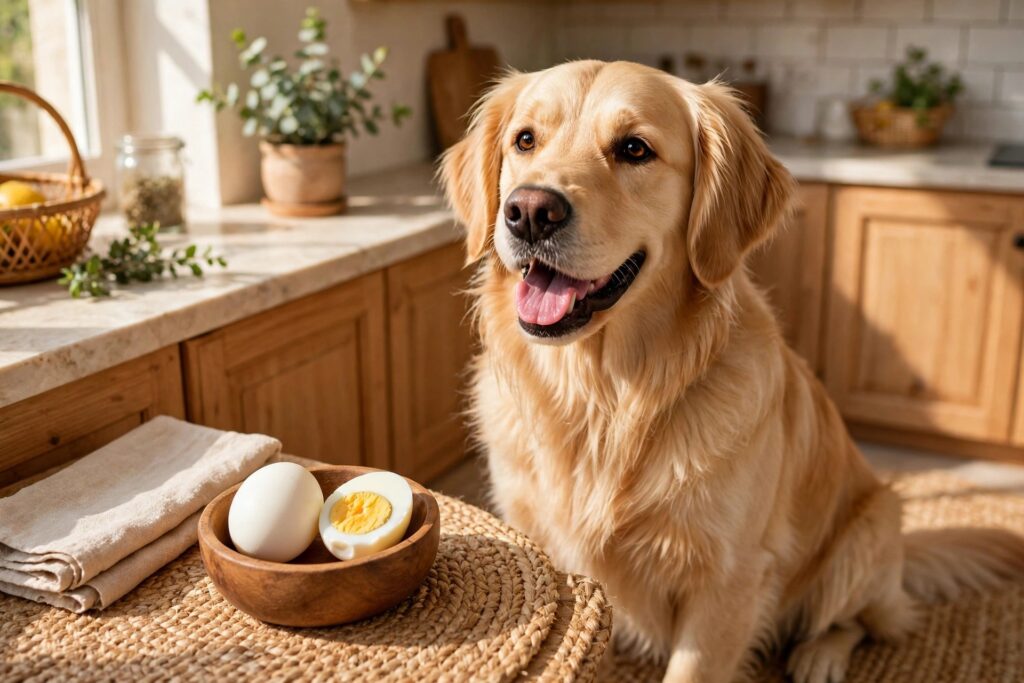
Yes — dogs can eat eggs, as long as they’re fully cooked and completely plain.
That’s the short answer to can dogs eat eggs, and it’s the one vets keep giving: a plain boiled or scrambled egg is a genuinely good treat. The catch is in the cooking. Raw eggs carry real risks, and the way most of us cook eggs for ourselves — butter in the pan, salt, a handful of cheese, maybe some onion — turns a healthy treat into something your dog’s stomach will regret.
So can dogs eat eggs from your breakfast plate? Only if that plate never saw the butter, the salt, or the seasoning. Cook one plain, just for them, and you’ve got one of the cheapest, easiest treats in your kitchen.
Key takeaways
- Yes, dogs can eat eggs — fully cooked, plain, with nothing added.
- Never feed raw eggs: salmonella risk plus avidin, a protein in raw egg white that blocks biotin absorption. Cooking fixes both problems.
- Keep eggs inside the 10% treat rule — for most dogs that’s 1–3 eggs per week, not one every morning.
- A large egg has about 70 calories, 6 grams of protein, and 5 grams of fat — small numbers that add up fast in a little dog.
- Skip butter, oil, salt, cheese, garlic, onion, and seasoned omelette fillings. Plain means plain.
- Watch for egg allergy (itching, ear infections, tummy trouble) and skip eggs if your vet has your dog on a low-fat or prescription diet.
Are eggs good for dogs?
Ask a vet can dogs eat eggs and you’ll usually get an enthusiastic yes, with the cooked-plain condition attached. The American Kennel Club lists eggs as safe for dogs when fully cooked, and the reason is the nutrition packed into such a small package. Egg protein is about as complete as protein gets — all ten essential amino acids dogs need, in a form their bodies use really well. You also get choline, selenium, riboflavin, and vitamin B12 in there, plus healthy fats from the yolk.
One large egg (about 50 grams) runs roughly 70 calories, 6 grams of protein, and 5 grams of fat. That’s a solid little bundle for a treat — but it’s also why portion matters. Seventy calories is nothing to a Great Dane and a real chunk of a Chihuahua’s whole day. An egg is a treat, not a meal replacement, and it should never push your dog’s regular food out of the bowl. Their kibble is already balanced; the egg is a bonus.
Can dogs eat raw eggs?
This is where can dogs eat eggs gets a firm no. Raw eggs carry two separate problems, and neither is worth gambling on.
Salmonella. Raw eggs can carry salmonella bacteria, and dogs can absolutely get sick from it — vomiting, diarrhea, fever, and a miserable few days. There’s a second risk people forget: a dog shedding salmonella in their stool can pass it to you, your kids, or anyone cleaning up after them. Cooking the egg all the way through kills the bacteria for both of you.
Avidin and biotin. Raw egg whites contain avidin, a protein that binds biotin (a B vitamin) and stops your dog’s body from absorbing it. One raw egg won’t cause a deficiency — a dog would need to eat raw whites regularly for that — but there’s no reason to run the experiment. Heat breaks avidin down, so a cooked egg gives your dog the biotin instead of blocking it.
Some raw-feeding guides still recommend raw eggs, and you’ll see the argument online. Vets who answer can dogs eat eggs raw tend to land in the same place: the small upside isn’t worth the bacterial risk, especially in a house with kids, older folks, or anyone with a weaker immune system. Cook it, and you keep everything good about the egg and drop both risks.
What about the shell? Crushed, baked eggshell is sometimes used as a calcium supplement, but that’s a vet conversation, not a kitchen improvisation. Shells can carry bacteria too, and too much calcium causes its own problems — especially in puppies and large-breed dogs still growing. Skip the shell unless your vet tells you otherwise.
How many eggs can my dog eat?
Can dogs eat eggs every day? They could, but most dogs do better when eggs stay a few-times-a-week treat. The vet rule for all treats applies here: treats, eggs included, should stay under 10% of your dog’s daily calories. In real portions, that works out like this:
| Dog size | Example breeds | Per serving | How often |
|---|---|---|---|
| Extra-small (under 10 lbs) | Chihuahua, Yorkie | About 1/8 of an egg, scrambled | 1–2 times a week |
| Small (10–25 lbs) | Beagle, Dachshund | About 1/4 of an egg | 2 times a week |
| Medium (25–60 lbs) | Border Collie, Cocker Spaniel | About 1/2 an egg | 2–3 times a week |
| Large (60–100 lbs) | Labrador, Golden Retriever | 3/4 to 1 whole egg | 2–3 times a week |
| Extra-large (100+ lbs) | Great Dane, Mastiff | 1 whole egg | Up to 3 times a week |
Those fractions look fussy, but in practice it’s simple: scramble one egg, give your little dog a spoonful, and eat the rest yourself. First time? Give a small taste and wait a day. If their stomach stays calm and their poop looks normal, you’re good to move up to the portion above. Puppies can have a tiny taste once they’re eating solid food, but keep it small — their stomachs are still figuring the world out, and rich food hits them harder.
How do I cook eggs for my dog?
If you’re asking can dogs eat eggs from your own breakfast, the answer is: only if you cook theirs separately. Here’s the plain version, three ways:
Hard-boiled. The easiest. Boil, cool, peel, chop. No salt in the water needed, nothing added after. Chopped boiled egg over kibble is the classic for a reason.
Plain scrambled. Non-stick pan, no butter, no oil, no milk, no salt. Just the egg, stirred until fully set. It looks boring. Your dog will not care.
Poached. Another clean option — egg in simmering water until the white is fully set and the yolk is firm. No vinegar tricks needed; keep it simple.
Whichever way you cook them, the yolk and white should both be fully set — no runny yolk, no wobbly white. That’s the line between cooked and raw, and it’s the whole safety rule in one sentence.
Now the kitchen traps — the things that sneak into a “plain” egg in a real kitchen:
- Butter and oil. They turn a 70-calorie egg into a 100-calorie one and can trigger an upset stomach or, in sensitive dogs, pancreatitis.
- Salt and seasoning. Dogs don’t need it, and seasoned salt blends often contain garlic or onion powder.
- Cheese. A little grated cheese feels harmless, but it adds fat and salt fast, and many dogs don’t digest dairy well.
- Garlic and onion. Both are toxic to dogs, and they hide in omelette fillings, breakfast sausage, and seasoning mixes.
- Your leftovers. A bite of your omelette sounds generous, but your omelette has at least two of the things on this list. Cook theirs separately — it takes three minutes.
Easy ways to serve eggs to your dog
Once you’ve answered can dogs eat eggs with a yes in your own kitchen, here are the servings dogs actually get excited about:
- Chopped boiled-egg topper. Dice a hard-boiled egg over their regular kibble. The smell alone usually gets a tail going.
- Plain scrambled spoonful. A warm spoonful of plain scrambled egg, cooled to room temperature, on its own or mixed into dinner.
- Lick-mat mash. Mash a boiled yolk with a little plain pumpkin purée and smear it on a lick mat — slow, calming, and great for a dog who inhales food.
- Training-treat crumble. Chop a boiled egg white into pea-size bits for training sessions. Low-calorie, high-value, and you can use them again and again — they pair well with the treat ideas in our guide to the best training treats for dogs.
- Veggie bowl topper. A little chopped egg over plain steamed veggies makes a boring bowl interesting, and it sits nicely next to other safe foods — our apples guide and bananas guide cover two more easy ones.
Cooked eggs keep in the fridge for up to four days if you don’t serve them right away. After that, toss them — a fridge egg older than that isn’t a treat anymore.
When should dogs skip eggs?
Most dogs handle eggs fine, but a few situations call for a no — or at least a vet check first:
- Egg allergy. Some dogs are allergic to egg protein. Watch for itchy skin, ear infections that keep coming back, paw licking, or tummy trouble after eating egg. If you see that pattern, stop and tell your vet.
- Pancreatitis or a low-fat diet. The yolk is where the fat lives. Dogs with pancreatitis or on a prescription low-fat diet usually need to skip eggs, or stick to whites only if the vet says so.
- Kidney disease. Eggs are high in phosphorus, which matters for dogs with kidney issues. Vet call first.
- Overweight dogs. An egg is a calorie-dense treat for a small or overweight dog. It can still fit, but it has to come out of the daily treat budget, not on top of it.
- Puppies on a growth diet. A tiny taste is fine, but growing puppies — especially large breeds — need their diet kept precise. Don’t let treats crowd out their puppy food.
If your dog has any medical condition and you’re unsure, a quick vet call beats guessing. Eggs are common enough that your vet will have a straight answer in seconds.
What if my dog already ate a raw egg?
First, don’t panic. One stolen raw egg is unlikely to turn into an emergency — most healthy adult dogs get through it without a problem. But watch them for the next day or two for vomiting, diarrhea, lethargy, or loss of appetite, and keep the yard clean while you’re at it, since salmonella can pass through their stool.
Call your vet if you see any of those signs, if your dog is a puppy, elderly, or already dealing with health problems, or if they ate a large amount — say, a whole carton raided off the counter. If you’re ever unsure, call. The ASPCA Animal Poison Control Center is at (888) 426-4435, and the Pet Poison Helpline is at (855) 764-7661. Both are worth saving in your phone before you need them.
Can dogs eat eggs — questions owners actually ask
Can dogs eat egg yolks? Yes, cooked yolks are fine and carry most of the nutrients. They’re also where the fat lives, so dogs on low-fat diets or watching their weight should get smaller portions.
Can dogs eat egg whites? Yes, cooked whites are fine too — and they’re the leaner half, mostly protein with almost no fat. If your vet has your dog on a low-fat diet but still allows eggs, whites are usually the part they mean.
Can dogs eat scrambled eggs? Yes, as long as they’re plain — no butter, oil, milk, salt, or cheese. A plain scrambled egg is one of the easiest ways to serve them.
Can puppies eat eggs? Yes, in tiny amounts once they’re on solid food. One small taste to start, and watch their stomach for a day before giving more.
Can dogs eat eggs every day? They can have a small amount daily if it stays under 10% of their calories, but 1–3 times a week is a safer rhythm for most dogs. Treats should stay treats — and if eggs are an everyday thing, the calories quietly stop being a treat.
Are eggshells safe for dogs? Only with vet guidance. Raw shells can carry bacteria, and extra calcium causes problems in growing puppies and large breeds. Don’t add shells on your own.
So, can dogs eat eggs?
Yes — can dogs eat eggs? Cooked yes, raw no, plain always, and a few times a week rather than every morning. Boil one or scramble one with nothing in the pan, keep it inside the portion table, and skip the butter, salt, and omelette fillings. That’s the entire playbook, and it’s one of the easiest wins in your kitchen: a treat your dog loves, that you already have in the fridge, with nothing to buy and nothing complicated to remember. If you want another easy one next, apples and bananas work the same way — plain, small, and a few times a week.