
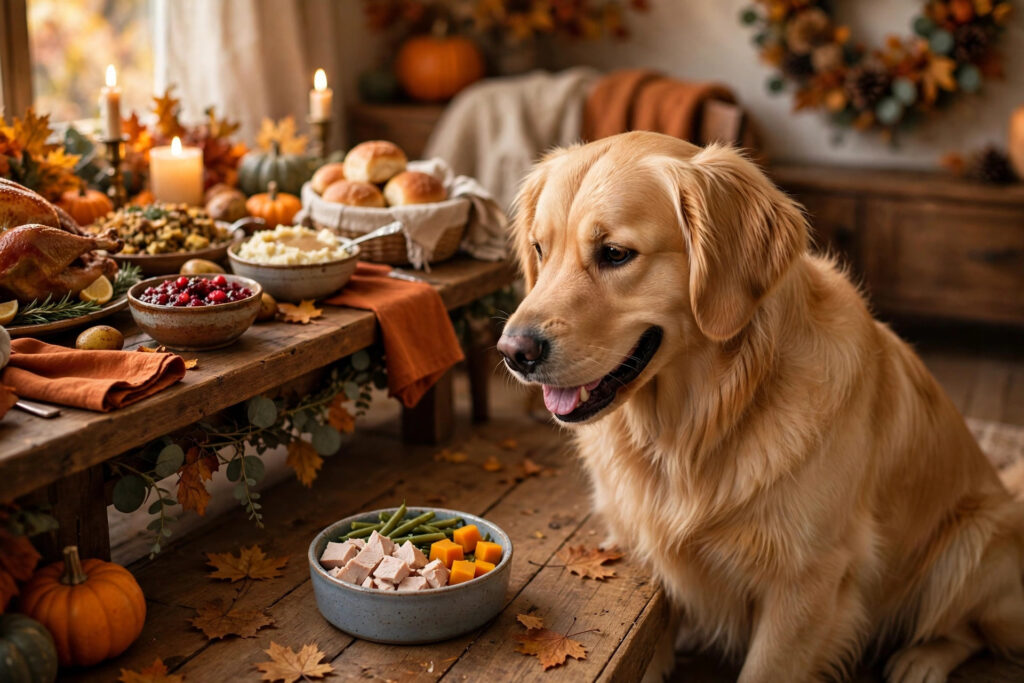
Yes — some of your Thanksgiving leftovers are fine for your dog. Plain turkey, plain sweet potato, plain pumpkin, green beans, carrots. A few small bites, and your dog gets a little taste of the holiday without a vet visit.
But here’s the part most guides skip: a leftover is not the same food the next day. The turkey that was safe on Thursday can be a problem by Saturday, and the stuffing that was dangerous on Thursday is still dangerous on Sunday. Fat doesn’t leave. Salt doesn’t leave. Onion doesn’t cook out. And reheating fixes none of it.
So this isn’t another safe-or-unsafe list for the feast itself — our Thanksgiving foods guide already covers the day itself, dish by dish. This is the day-after guide: what survives the fridge, what to toss, the 4-day watch after a fatty bite, and what to do when your dog already helped themselves.
Key takeaways
- Plain, boneless, skinless turkey is the only meat that makes the cut — a few small bites, inside the 10% treats rule.
- Bones, skin, gravy, stuffing, and anything with onion, garlic, grapes, chocolate or xylitol stay off the plate, every single day of the weekend.
- Pancreatitis signs can show up 4 days after a fatty meal — and every new plate of leftovers restarts that 4-day clock.
- Swallowed a cooked bone? Never make your dog vomit. Call your vet the same day, even if your dog looks fine.
- Fridge rule: if you wouldn’t eat it yourself by day 3 or 4, your dog shouldn’t either. Reheating doesn’t make a risky leftover safe.
- Poison lines that answer on Thanksgiving: ASPCA Animal Poison Control (888) 426-4435, Pet Poison Helpline (855) 764-7661.
What can my dog actually eat from the leftovers?
The trick is to set your dog’s plate aside before the seasoning starts. Once the butter, salt and garlic go in, the dish stops being dog food. Here’s what earns a spot on the day-after plate:
Plain turkey breast. Boneless, skinless, fully cooked, no brine, no rub, no gravy on top. White meat beats dark meat here — dark meat carries more fat, and fat is the whole problem with leftovers. Turkey’s closest cousin on this site is chicken, and the rule is identical: plain and boneless, or it doesn’t happen.
Plain sweet potato. Baked or boiled, nothing on it. Not the casserole buried under marshmallows and brown sugar — that’s dessert, and it stays yours.
Plain pumpkin. The pure cooked kind, or canned pumpkin that says “pumpkin” and nothing else on the label. Fiber-rich, easy on the stomach, and one of the few leftovers that’s genuinely good for a dog.
Plain green beans and carrots. Raw or cooked, no butter, no casserole sauce. Carrots are an easy win here — most dogs crunch them happily, and they were probably the plainest thing on the table anyway.
Apple slices. No seeds, no core, nothing coated in sugar or caramel. Apples are fine, but keep it to a couple of slices.
Corn kernels off the cob. Small amounts only. The cob itself never makes the plate — it’s a classic blockage risk.
How much is “a few small bites”? Treats and table food together should stay under 10% of your dog’s daily calories — that’s the vet nutrition guideline the AKC repeats every holiday. For most dogs that means a spoonful or two of turkey and a bite of sweet potato, not a second dinner. And if your dog has diabetes, kidney disease, a pancreatitis history, food allergies, or a prescription diet, skip table food entirely unless their own vet says otherwise.
Which leftovers never make it onto the plate?
Some dishes are a hard no on Thursday, and they’re a hard no on Friday, Saturday and Sunday too. The fridge doesn’t fix them.
| Safe (plain only, small bites) | Iffy (tiny taste at most, or skip) | Never |
|---|---|---|
| Plain turkey breast | Dark meat turkey (fattier) | Cooked turkey bones — any bone, wishbone, neck, carcass included |
| Plain sweet potato | Mashed potatoes as served (butter, cream, garlic) | Turkey skin, fat trimmings, drippings, gravy |
| Plain pumpkin | Plain baked roll | Stuffing (onion and garlic, sometimes raisins) |
| Plain green beans, carrots | Cheese and dairy | Onion, garlic, leeks, chives — raw, cooked or powdered |
| Apple slices, no seeds | Grapes and raisins | |
| Corn kernels off the cob | Chocolate, sugar-free desserts (xylitol), pumpkin pie, ham, alcohol, corn cobs, raw dough |
Why the Never column is so long: cooked turkey bones turn brittle and splinter, and they can choke a dog or tear and block the gut. Turkey skin, fat and gravy are concentrated fat — the AKC and the AVMA both link rich, fatty meals to pancreatitis, and it only takes a small amount. Stuffing is usually built on onion and garlic, and the whole allium family damages a dog’s red blood cells whether it’s raw, cooked, dried or powdered — the Merck Veterinary Manual notes the signs can take several days to show up. Grapes and raisins can cause sudden kidney failure, even in small amounts, according to the ASPCA and the Pet Poison Helpline. Chocolate carries theobromine and caffeine. Xylitol, the sweetener in sugar-free desserts, can crash a dog’s blood sugar and damage the liver. Ham is a salt-and-fat bomb with the same pancreatitis risk. And raw yeast dough keeps rising in a warm stomach while the fermenting yeast produces alcohol.
One more thing about cranberries: the fresh berries aren’t toxic, just so tart most dogs walk away after one sniff. The sauce, though, is basically dessert — sugar, sometimes orange liqueur — and it stays off the plate.
How long do leftovers stay safe in the fridge?
Day 2 is the easy one. If the food was plain, went into a sealed container within a couple of hours of the meal, and spent the night cold, it’s the same food it was yesterday. Serve it cold or gently warmed — your dog won’t care either way.
Day 3 and 4 are the edge. Use your own nose and your own judgment: if you wouldn’t eat that turkey yourself by now, don’t serve it to your dog. A dog’s stomach isn’t tougher than yours — it’s more sensitive to rich food, not less.
And reheating is not a reset button. Heat kills germs. It does not remove fat, salt, onion, garlic or xylitol. A reheated spoonful of stuffing is still stuffing. A reheated piece of skin is still a lump of fat. If a dish was unsafe on Thursday, the microwave doesn’t make it safe on Saturday.
The turkey carcass deserves its own warning. Don’t leave it sitting on the counter “for stock” where a dog can reach it, and don’t toss it in an open trash can. Bones, string, foil and fatty scraps in one place is exactly the raid your dog is planning while you’re still saying goodbye to guests.
What is the 4-day pancreatitis watch?
This is the part nobody puts on a fridge magnet, and it’s the reason the day-after plate matters more than the feast itself. A fatty meal can inflame the pancreas — pancreatitis — and the signs don’t always show up the same night. Vomiting, diarrhea, loss of appetite, belly pain, a hunched back, weakness: they can appear up to 4 days after the fatty meal, according to the Pet Poison Helpline.
Which means the clock restarts with every plate. Turkey skin on Thursday, gravy on Friday, ham on Saturday — that’s not one risk, that’s three fresh 4-day windows stacked on top of each other. The dog who seemed fine on Friday night can be sick on Monday.
So after any rich bite, watch for 4 full days. Mild stomach upset after a tiny taste usually settles, but repeated vomiting, a painful belly, or a dog who won’t eat needs a vet call the same day — not a “let’s see how tomorrow goes.” And if your dog has had pancreatitis before, skip turkey entirely unless their own vet says otherwise.
My dog already ate it — what do I do now?
First, don’t panic. Then figure out which of these three cases you’re in, because the right move is different for each one.
They swallowed a cooked bone. Do not make your dog vomit — that can do more damage on the way back up. Call your vet the same day, even if your dog seems completely fine. Then watch for choking, dry retching, repeated vomiting, a painful belly, or signs of bloat. Any of those is an emergency vet visit right now, not tomorrow.
They got into fatty food — skin, gravy, ham, drippings. A small amount and a dog acting normal: go back to their regular food, keep the next few days plain, and watch for 4 days. A large amount, or any vomiting, diarrhea or belly pain: call your vet the same day and tell them exactly what and how much.
They ate something toxic — stuffing with onion or garlic, grapes or raisins, chocolate, a sugar-free dessert, alcohol. Call a poison line now, even if your dog looks perfectly normal. ASPCA Animal Poison Control: (888) 426-4435. Pet Poison Helpline: (855) 764-7661. Both take calls on Thanksgiving, and fees may apply. Don’t wait for symptoms — with onion and garlic, the red blood cell damage can take days to show up, and by then you’ve lost the window where a vet can act early. Have the dish, the ingredients and roughly how much your dog ate ready when you call.
One thing that applies to all three: write down what they ate and when. Vets and poison lines both ask, and “I think it was the stuffing, maybe an hour ago” is a much better answer than a guess made in a panic.
How do I stop round two — the trash raid and the guests?
The feast ends, but the risk doesn’t. Most Thanksgiving vet visits after the meal itself come from the next 48 hours: the trash, the guests, and the dessert table.
Secure the trash. A Thanksgiving trash can is a minefield — bones, foil, string, fatty scraps. Tie the bag shut or shut the door on the can. If your trash lives under the sink, check the cabinet latch actually holds against a determined nose.
Brief your guests out loud. Before dinner, say it plainly: “please don’t feed the dog from your plate.” Most accidents are a well-meaning relative slipping scraps under the table. Our Thanksgiving foods guide has the full day-of list if a guest wants to check a dish before it hits the table.
Make the dog their own plate. Set aside the plain turkey, green beans and pumpkin before you season everything, and serve it when everyone sits down. A dog with their own plate begs less, and it stops the “just one bite” negotiations for the rest of the evening.
Push the dessert table back. Pies, chocolate, anything sugar-free — the highest-risk items of the day, all at counter-surfing height. And give your dog a quiet room with their bed when the house gets loud. A house full of people and strange smells is a lot for a dog, and a calm dog is a dog who isn’t raiding the kitchen while you’re distracted.
Frequently asked questions
Can dogs eat Thanksgiving leftovers the next day?
Yes — the plain ones. Plain turkey breast, plain sweet potato, plain pumpkin, green beans and carrots are fine on day 2 in small bites, as long as they were refrigerated promptly. Bones, skin, gravy, stuffing and anything seasoned stay off the plate.
Can dogs eat turkey the day after Thanksgiving?
Plain, boneless, skinless, fully cooked turkey is fine for 3 to 4 days if it was refrigerated within a couple of hours of the meal. After that, or if it smells off, toss it. Skip dark meat for dogs with sensitive stomachs — it’s fattier than breast meat.
Can dogs eat stuffing leftovers?
No. Traditional stuffing is built on onion and garlic, sometimes with raisins, and all three are toxic to dogs. Reheating doesn’t help. It goes in the trash, not the dog’s bowl.
Can dogs eat mashed potato leftovers?
Only the truly plain kind — and let’s be honest, that’s not what’s on your table. Standard mashed potatoes have butter, cream, salt and usually garlic. A plain boiled potato is the safe swap.
What should I do if my dog ate a cooked turkey bone?
Don’t make your dog vomit. Call your vet the same day, even if your dog seems fine, and watch for choking, dry retching, repeated vomiting or a painful belly. Any of those means an emergency vet visit right away.
So, what’s the one rule for the whole weekend?
Plain, small, and only for a few days. Set your dog’s plate aside before the seasoning starts, toss the bones and the gravy, and if something went wrong, call — don’t wait and watch. Your dog doesn’t need a second Thanksgiving. A few safe bites and their own bed will do.