
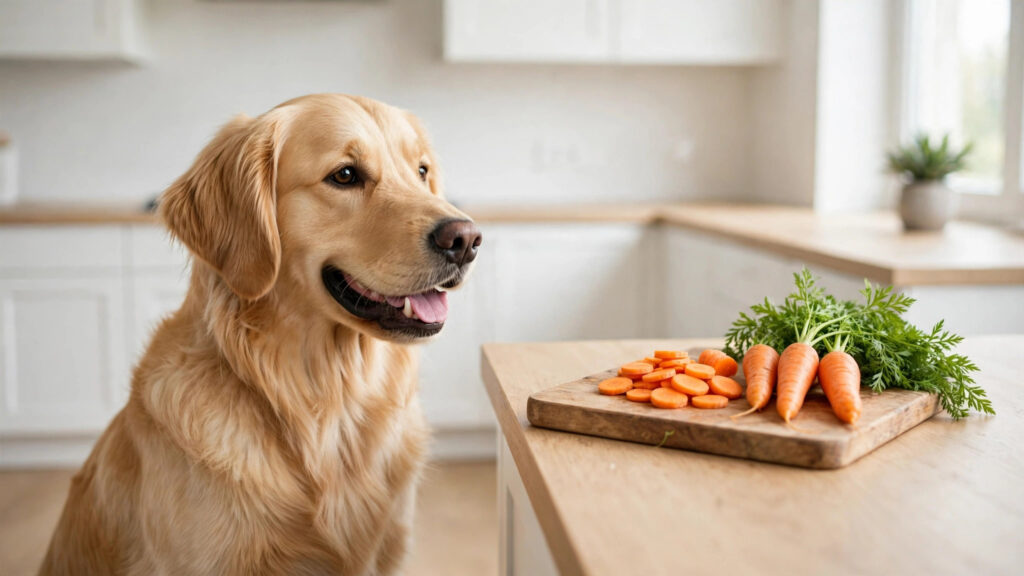
Yes, dogs can eat carrots, raw or cooked, plain, and cut into pieces that match your dog’s mouth.
That is the short answer to can dogs eat carrots, and it comes with a twist most articles skip. The carrot itself is not the problem. No toxin hides in it, and it sits nowhere on the ASPCA avoid list. The problem is the shape it arrives in. A whole carrot is a hard, smooth stick, and a baby carrot is a smooth, round plug about the width of a medium dog’s airway. Either one can lodge in a throat or block a gut if a dog gulps it whole. Cut the same carrot into thin coins or small sticks, and it turns into one of the safest treats in your fridge.
So can dogs eat carrots off your cutting board? Yes, a few small plain pieces, most days if you like, inside the portion table below. Wash them first, cut them no bigger than their kibble for a small dog, and skip anything that came out of a pan with butter, honey, onion or garlic in it. That is the whole deal.
Key takeaways
- Yes, dogs can eat carrots, plain, raw or cooked, cut into bite-size pieces.
- Carrots are not toxic to dogs. The real risks are choking on a whole carrot or a baby carrot, stomach upset from too much fiber, and natural sugar for diabetic dogs.
- Keep carrots inside the 10% treat rule: treats of every kind together stay under 10% of daily calories.
- One medium carrot carries only about 25 calories, one baby carrot about 4 calories, and a carrot is roughly 88% water.
- Cut slices about 1/4-inch thick. Slice baby carrots lengthwise into quarters for small dogs and halves for medium dogs. Never serve a whole baby carrot to a small dog.
- Frozen carrots split the experts: PetMD warns they can choke and damage teeth, while Petful and the AKC call a frozen whole carrot a useful supervised teething chew. The safe middle path is in the frozen section below.
- A medium carrot carries about 3 grams of natural sugar, so diabetic dogs need a small, consistent portion and a vet’s sign-off first.
- Carrot tops and greens are non-toxic in small amounts, but only from carrots you bought or grew yourself. Wild carrot looks like poison hemlock.
- First time? One or two small pieces, then watch for 24 hours before offering more.
Are carrots good for dogs?
Ask a vet can dogs eat carrots and you will get one of the happiest yeses in dog food. The question can dogs eat carrots comes up so often because carrots sit in almost every fridge, and the answer is kinder than most vegetables earn. The American Kennel Club calls carrots a healthy, low-calorie snack, and an excellent source of vitamin A, potassium and fiber. PetMD goes further and lists the perks: eye health, digestion, skin and coat, from the vitamins, minerals, fiber and antioxidants inside. Both agree on the reason: carrots give a dog a lot of crunch and nutrition for almost no calories.
Here is what is in it. A medium carrot runs about 25 calories, a baby carrot about 4 calories, and 100 grams of raw carrot runs about 41 calories with 2.8 grams of fiber and almost no fat, according to USDA figures quoted by Petful. A carrot is roughly 88% water, so it fills a hungry dog up without filling the calorie budget. For a dog on a diet, that combination is hard to beat. A biscuit with the same crunch costs many times the calories and does nothing for hydration.
The crunch does one more quiet job. PetMD notes that the natural crunch helps satisfy a dog’s urge to chew, and chewing a firm raw carrot can scrape a little soft plaque off the teeth while a dog works on it. Petful says the same thing, with the same limit: it does not replace brushing or a dental cleaning. It is not a toothbrush, and it will not fix tartar that is already there, but as treats go, it is one of the few that helps the mouth instead of hurting it.
The star nutrient is beta-carotene, the pigment that makes carrots orange. The body converts beta-carotene into vitamin A, which supports vision, immune function, skin and coat. Petful adds a point most articles leave out: dogs on a complete commercial diet already get enough vitamin A, so carrots are a bonus, not a supplement. You are not fixing a deficiency with a carrot. You are giving a healthy dog a healthy extra.
But carrots are a treat, not a meal. They do not replace kibble, and they do not need to. Their regular food is already complete. The carrots are the bonus on top, and if they start crowding out their normal food instead of topping it, they are quietly losing nutrition while you think you are feeding them better.
The size is the risk
Here is the part that matters most when you ask can dogs eat carrots, and it is the part most articles bury under the nutrition list.
Carrots are safe. The size is not. PetMD says it plainly: large pieces of carrot may get stuck in a dog’s throat or cause an intestinal blockage, so always cut them into bite-size pieces. The AKC says the same thing in different words, and tells owners to cut whole carrots and carrot sticks into bite-size chunks before feeding them to a dog.
Baby carrots deserve a warning of their own, because they look safe and they are not. A baby carrot is a regular carrot cut and shaped into a smooth, round plug, and Petful points out that a whole baby carrot is about the width of a medium dog’s airway. A small dog or a fast eater can swallow one whole without chewing, and that is exactly the shape that lodges. Slice each baby carrot lengthwise into quarters for small dogs and into halves for medium dogs. Give a whole baby carrot only to a large dog that actually chews, and watch it eat.
The fix takes about thirty seconds, and it removes the one real physical danger in this vegetable. Wash the carrot under running water to remove dirt and pesticide residue, then cut it to match the jaw in front of you. PetMD’s rule is slices about 1/4-inch thick. For a small dog, cut those coins into half-moons or shred the carrot, which Petful calls the safest raw form for toy breeds. For a medium dog, thin coins or sticks work. For a large dog that chews before swallowing, a raw stick under supervision is fine, and you take it away once it gets small enough to swallow.
That is also why cooked carrots can be easier for some dogs. Steaming or boiling softens the tough cell walls, so a cooked piece breaks apart instead of holding its shape, and PetMD notes that carrots provide more nutrients when cooked. Plain cooked carrots are fine, as long as they were cooked in water and nothing else. The moment butter, salt, oil or a seasoning blend joins the pot, it stops being plain, and the next sections explain why that matters.
How many carrots can my dog have?
This is where most articles on can dogs eat carrots trip over themselves, because the best sources give their portions in different units, and a reader asking can dogs eat carrots safely needs one table, not three different ones. PetMD counts in 1/4-inch slices, Petful counts in baby carrots per day, and other guides count in whole carrots or fractions of a regular carrot, and nobody puts them together. The table below does. It uses Petful’s baby-carrot table as the base, adds the medium-carrot amounts alongside, and stays inside the 10% rule throughout.
| Dog size | Weight | Carrots per day | About how many calories |
|---|---|---|---|
| Extra-small | Under 10 lbs | 1-2 baby carrots, finely chopped | 4-8 |
| Small | 10-25 lbs | 2-4 baby carrots, sliced | 8-16 |
| Medium | 25-50 lbs | Half to one medium carrot | 12-25 |
| Large | 50-90 lbs | One medium carrot | About 25 |
| Extra-large | Over 90 lbs | One to two medium carrots | 25-50 |
A quick reality check on those numbers, using Petful’s worked example: a moderately active 20-pound dog needs roughly 400 to 550 calories a day, which leaves about 40 to 55 calories for all treats. Three baby carrots, at about 4 calories each, use only 12 of those calories, so carrots leave room for the training treats your dog also earns. That is why carrots work so well as a weight-loss swap. They add volume without many calories, and the American Animal Hospital Association suggests them as a low-calorie snack alternative to processed treats.
What sets the limit is fiber and sugar, not calories. A dog that eats a whole bag of carrots will not be poisoned, but it will very likely spend the evening with gas, loose stools, and a sore stomach. Too much fiber does that, and carrots are a fibrous vegetable. Petful puts it well: because carrots are so light, the limit you hit first is usually fiber, not calories.
The 10% rule is the same one that governs every treat. Treats and toppers together should stay under 10% of your dog’s daily calories, and the other 90% should come from their complete food. Count the carrots in that budget, not on top of a full bowl plus the usual treats. And count the other vegetables too. A spoonful of peas and carrots on top of dinner is fine, but peas are richer in calories and protein than carrots, so measure them more carefully.
One number worth knowing is sugar. A medium carrot carries about 3 grams of natural sugar, which is high for a vegetable. A healthy dog has nothing to worry about at the portions above. But if your dog is diabetic, that sugar is the one quiet reason carrots are not a free-for-all, even though the calories are. Give the same small portion at the same time each day, and check with your vet how it fits the insulin plan. That rule is in the who-should-go-easy section below, with the vet names attached.
First time? Give one or two small pieces and wait 24 hours. If their stomach stays calm and their poop looks normal, move up to the portion above. PetMD gives the same advice: start slowly and watch for vomiting or diarrhea, and if anything seems off, stop feeding carrots and call your vet.
Can dogs eat raw carrots?
Yes, raw carrots are fine, and for most adult dogs raw is the best form. Raw keeps the crunch, keeps the fiber intact, and gives a bored dog something to gnaw. Wash them, cut them small, and serve them plain. The same 10% limit applies. Raw does not change anything about the safety math, and most vet guides treat raw as the default way to serve carrots.
Lightly steamed or boiled is the gentlest form, and it is the one to pick for a first feed, for a small dog, or for a dog with a sensitive stomach. Cooking softens the fibers, which takes the choking risk down further, and it makes some of the beta-carotene easier to absorb. PetMD says carrots provide more nutrients when cooked, which is the opposite of most vegetables. Just let the pieces cool before serving. A hot piece straight out of the pot is a burned mouth.
What never works is seasoned carrots. Carrots from your dinner usually arrive with butter, salt, honey, or a seasoning blend, and seasoning blends often hide garlic or onion powder. Garlic and onion are toxic to dogs in every form, raw, cooked, or powdered. The carrot underneath is fine. Everything on top of it is the problem. Cook a plain piece just for them, or pick out plain pieces before the seasoning goes on.
Two kitchen traps deserve a name. The first is carrot cake. PetMD calls it a no, and Petful lists why: raisins are often baked in and toxic to dogs even in small amounts, walnuts and pecans add fat and can carry mold toxins, sugar-free versions may use xylitol, which can drop a dog’s blood sugar dangerously within an hour, and nutmeg in large amounts is toxic. The carrot in the cake is fine. Nearly everything else in the slice is the problem. The second trap is the glazed carrot. Honey-glazed, buttered, pickled, and ranch-dressed carrots are all out, for the same reasons: sugar, fat, salt, garlic, and onion powder.
What about frozen carrots?
This is the one place where the big sources openly disagree on can dogs eat carrots frozen, so here is the disagreement, honestly, instead of a picked side.
PetMD says frozen carrots are not good treat options. Frozen pieces are choking hazards and can also damage a dog’s teeth. That is a real risk. A rock-hard frozen chunk can crack a tooth in a small dog, and a frozen baby carrot is the same plug shape as a fresh one, only harder.
Petful says the opposite, and the AKC agrees with Petful. A frozen whole carrot is a cheap, supervised teething chew for puppies, and a cold carrot gives sore gums something to press on, which can ease the urge to chew furniture. For adult dogs, frozen carrot coins are a crunchy, low-calorie cool-down snack on a hot day.
Both sides are describing a real carrot, just a different one. The safe middle path is to follow the form, not the slogan. Freeze a whole large carrot as a supervised chew for a medium or large puppy, and take it away when it gets small enough to swallow. Thaw it slightly for small dogs, cut it smaller for toy breeds, and never leave a puppy alone with a frozen carrot. Never feed frozen baby carrots, because they are the plug shape at its hardest. If your dog has worn teeth, a cracked tooth, or a history of gulping, skip frozen carrots entirely and serve them steamed instead.
Canned carrots sit in the same middle ground. Plain canned carrots are not toxic, but many cans are packed in salted water. Choose no-salt-added cans, drain and rinse them, and treat them as an occasional backup rather than a daily snack. Canned sliced carrots are already soft, so they suit senior dogs.
The tops paradox
Carrot tops, the feathery greens on top of a bunch, hold a small paradox of their own, and they are the part most can dogs eat carrots guides skip entirely.
Petful notes that carrot tops and greens are non-toxic to dogs and safe in small amounts. They are slightly bitter, so many dogs ignore them, and they are mostly fiber with a little vitamin K and vitamin C. Washed and chopped fine, a pinch mixed into food is safe. A salad of greens is not, because the extra fiber can loosen stools, and long stems can tangle and cause gagging.
So what should you do with the tops? If you bought the carrots or grew them yourself, wash the greens well, chop them fine, and mix a pinch into the bowl. If the tops came from a bunch you are not sure about, or your dog is grazing on a walk, leave them alone. Here is why that rule matters. Wild carrot, also called Queen Anne’s lace, looks very similar to poison hemlock and water hemlock, which are among the most toxic plants in North America for people and animals. Only feed greens from carrots you bought or grew yourself, and keep your dog from grazing on wild carrot-like plants on walks. If you think your dog ate an unknown wild plant, call your vet or ASPCA Animal Poison Control at (888) 426-4435.
Who should go easy on carrots?
For most dogs the answer to can dogs eat carrots is a yes. But a few dogs should go easy, or check with the vet first, and the reasons are specific, so the question can dogs eat carrots still needs a careful answer for them.
Diabetic dogs. This is the one clear go-easy group. A medium carrot has about 3 grams of sugar, so give the same small portion at the same time each day and check with your vet how it fits the insulin plan. PetMD flags the same point: too much sugar over time can be dangerous for dogs with diabetes and obesity. Carrots are still a better treat than a biscuit for most diabetic dogs, because they are low in calories and fat, but the portion has to stay small and steady.
Dogs with pancreatitis. Carrots are nearly fat-free, so many vets allow them once a dog has recovered. Avoid them during a flare, and cooked carrots are gentler than raw while the gut heals. Petful gives this one plainly, and it is worth following exactly: recovered yes, flare no.
Dogs with kidney disease. Carrots are fairly low in phosphorus, which helps, but they do contain potassium, so dogs on a renal diet should only get treats their vet approves. A prescription diet is doing a job, and unplanned extras can undo it, even healthy ones.
Dogs with sensitive stomachs or IBD. Many do well on small amounts of cooked carrot. Dogs with inflammatory bowel disease on a strict diet should not get extras without vet approval. The same fiber that helps a healthy dog can set off a real flare in a dog whose gut is already irritated.
Dogs on prescription diets. Same rule as kidney disease, check first. PetMD flags this one explicitly. A prescription diet is doing a job, and unplanned extras can undo it, even healthy ones.
Puppies. A tiny taste is fine once a puppy is fully weaned and eating solid food, usually around 8 weeks. Start with cooked or finely grated carrot, and move to small raw pieces once your puppy chews well. Keep the portion at one or two baby carrots, chopped, because their growth food needs to supply almost all of their calories. Wait until the adult teeth are in, around 6 to 7 months, before any whole-stick form, and even then supervise.
Seniors. Older dogs can eat carrots the same way younger dogs can, but two things change. Their digestion is often more sensitive, so gas and loose stools show up faster. And if they are on a prescription diet or medication, check with the vet first. Steamed carrots are the kindest form for a senior with worn teeth.
Dogs with a carrot allergy. A true carrot allergy is rare. Petful cites a review of canine food allergy studies that found the most reported allergens were beef, dairy, chicken and wheat, with vegetables like carrots far down the list. Watch for itching, ear infections, vomiting or diarrhea after carrots. If you see those signs, stop the carrots and talk to your vet. A food allergy is confirmed with an elimination diet, not a blood test.
Easy ways to serve carrots to your dog
Once you have answered can dogs eat carrots with a yes in your own kitchen, here are the servings that actually work:
- Crunchy topper. A few raw coins, cut small, over their regular kibble. It sits nicely next to other safe foods. Our eggs guide and chicken guide cover two more easy ones, and our broccoli guide and celery guide show the same plain-and-small rules on two more vegetables.
- Training reward. One small coin as a reward is a training treat with almost no calories. Dogs that work for food will work for carrots, and you can train longer without filling them up.
- Weight-loss swap. Replace a biscuit with a few carrot coins. Same crunch, a fraction of the calories, and a fuller-feeling dog. PetMD and the American Animal Hospital Association point to this exact swap for dogs on a weight-loss plan.
- Frozen chew. A frozen whole carrot on a hot day doubles as a chew and a cool-down, for a medium or large dog, supervised, taken away when it gets small. Once it thaws and softens, it is just a piece of carrot again.
- Veggie bowl mix. A little chopped carrot mixed with plain steamed peas or green beans turns a boring bowl into dinner. PetMD lists peas, sweet potatoes, celery and broccoli as dog-safe vegetables to mix with carrots. If you are cooking a holiday meal, the same plain rule applies. Our Thanksgiving foods guide covers what is safe on the table and what is not.
- Toy stuffer. Blend cooked carrots, let the mixture cool, and fill a rubber toy or spread it on a lick mat. Slow, calming, and great for a dog who inhales food.
Fresh carrots keep in the fridge for about two weeks if you keep them dry and wrapped. Cut pieces keep three to four days in a sealed container. After that, toss them. A limp piece from the back of the fridge is not a treat anymore. And if you are wondering what else from the produce drawer is safe, our apples guide and bananas guide cover two more everyday foods the same way.
What if my dog ate too many carrots?
First, do not panic, but do not wait and hope either. Carrots are not toxic, so a dog that ate a lot of carrots, such as raiding the bag meant for the Easter Bunny, usually ends up with nothing worse than a stomach upset from the fiber. That is the reassuring side of can dogs eat carrots: the danger is size and amount, not poison. The real danger is choking or a blockage from large unchewed chunks, not the carrot itself.
Watch for gas and bloating, loose stools or diarrhea, vomiting, especially if the carrots were eaten fast, and a painful or swollen belly. If your dog is straining without passing stool, drooling, or pawing at its mouth, a piece may be stuck. That is a vet visit right away, not a wait-and-see. If your dog is a puppy, elderly, or already dealing with health problems, call sooner rather than later.
Call your vet and tell them what happened: how many carrots, raw or cooked, and when they ate it. If you cannot reach your vet, the ASPCA Animal Poison Control Center is at (888) 426-4435, and the Pet Poison Helpline is at (855) 764-7661. Both are worth saving in your phone before you need them.
Do not try to make your dog vomit unless your vet tells you to. That can cause more damage on the way back up, especially if a hard piece is involved. Offer water, skip treats for the rest of the day, and let the vet decide what comes next.
Can dogs eat carrots: questions owners actually ask
Can dogs eat carrots every day?
Yes, a small daily portion is fine for most healthy dogs, as long as it fits the table above and stays inside the 10% treat budget. Petful says there is no evidence that a sensible daily serving causes harm. If stools turn loose or bulky, cut the portion or switch to every other day.
Can dogs eat raw carrots?
Yes, washed and cut into bite-size slices. Raw keeps the crunch and the fiber intact. If you let your dog eat an entire carrot, it could become a choking hazard or lead to an intestinal blockage, so cut it first.
Can dogs eat cooked carrots?
Yes, steamed, boiled, baked or roasted, plain, with nothing added. Cooked carrots are softer, easier to digest, and give up a little more of their beta-carotene. They are the gentlest form for puppies, seniors and sensitive stomachs.
Can dogs eat frozen carrots?
Yes, with the middle path above, and no, not as a hard plug. A frozen whole large carrot, supervised, for a medium or large dog, thawed slightly for a small dog, taken away when it gets small. Never feed frozen baby carrots, and never leave a puppy alone with one. PetMD warns frozen pieces can choke and damage teeth, so skip frozen carrots if your dog gulps or has worn teeth.
Can dogs eat baby carrots?
Yes, sliced. A baby carrot is a regular carrot cut and shaped, with the same nutrition at about 4 calories each. Slice each one lengthwise into quarters for small dogs and halves for medium dogs. A whole baby carrot is a choking size for many dogs.
Can dogs eat carrot cake?
No. The carrot is fine, nearly everything else in a slice is the problem: sugar, fat, raisins, nuts, xylitol and nutmeg. If your dog ate a slice with raisins, call your vet right away.
Can dogs eat carrot tops?
Yes, in small amounts, washed and chopped fine, from carrots you bought or grew yourself. They are non-toxic, bitter, and mostly fiber. Never feed greens from a wild carrot-like plant, because wild carrot looks like poison hemlock.
Can puppies eat carrots?
Yes, once fully weaned, usually around 8 weeks. Start with cooked or finely grated carrot, one or two baby carrots chopped, and move to small raw pieces once your puppy chews well. Frozen carrots help teething puppies, but size them so they cannot be swallowed, and stay with your puppy while it chews.
So, can dogs eat carrots?
Yes, can dogs eat carrots? Plain yes, small yes, cut to the jaw always. A few plain pieces, sliced about 1/4-inch thick, most days if you like, inside the portion table. That is the entire playbook, and it is one of the easiest wins in your kitchen: a treat your dog crunches happily, that you probably already have in the fridge, with nothing to buy and nothing complicated to remember. And if you want another easy one next, celery works the same way, plain, small, and a few times a week, as our celery guide shows.