
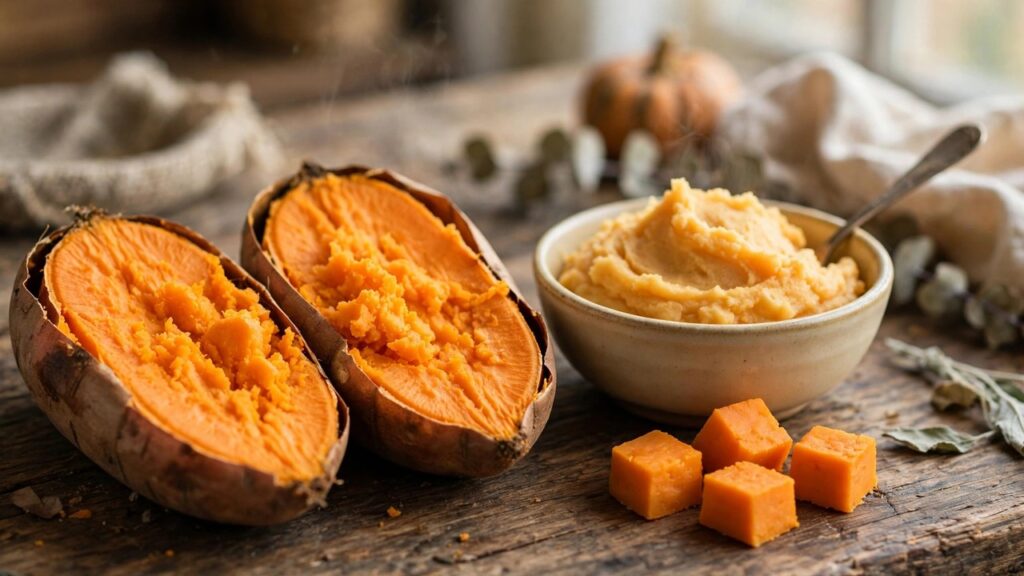
Yes. Dogs can eat sweet potatoes, and honestly, they’re one of the better things you can share from your plate. The American Kennel Club calls them low in fat and rich in fibre, vitamin A, B6 and C, plus potassium, calcium and iron. A spoonful of plain, fully cooked sweet potato is a genuinely good treat.
But here’s the part that trips people up every Thanksgiving: the sweet potato your dog can eat and the sweet potato on your table are usually two different foods. One is a plain root, boiled or baked until soft. The other is a casserole buried under marshmallows, brown sugar and butter. This guide covers both, plus the one version — the sugar-free one — that turns into a vet call.
What Makes a Sweet Potato Safe for Dogs?
Three words decide everything: cooked, plain, and portioned. Get those three right and there’s nothing to worry about. Break one of them and you’re in trouble.
Cooked means soft all the way through. A sweet potato should mash easily with a fork before it goes anywhere near your dog. Boiling, baking or steaming all work — the method matters far less than the softness. Plain means nothing added: no butter, no brown sugar, no marshmallows, no maple syrup, no salt, no seasoning. And portioned means a spoonful or two, not a whole potato and definitely not a second helping.
PetMD puts it the same way: dogs can eat sweet potatoes as long as they’re fully cooked, plain, and fed in moderation. The AKC agrees. Both of them are really saying the same thing — the root itself is fine, the preparation is where it goes wrong.
One thing worth saying plainly: your dog doesn’t need sweet potato for the vitamins. A dog on a complete, balanced diet already gets what it needs. The vitamins are a nice bonus, not a reason to start feeding it every day. Feed it because it’s a good treat, not because it’s medicine.
Can Dogs Eat Raw Sweet Potatoes?
No. And this is where sweet potatoes get confusing, because raw sweet potato is not poisonous — but you still shouldn’t feed it.
Raw sweet potato is dense, hard and starchy. A dog that crunches through a raw chunk can end up with stomach upset, gas or vomiting, and a swallowed piece can lodge badly enough to cause an intestinal blockage. The AKC warns that raw sweet potato is hard to chew, can upset the stomach and may cause a blockage. PetMD says the same.
So the rule is simple: always cook it. Boil it, bake it or steam it until it’s soft enough to mash with a fork. If you’d hesitate to mash it, it’s not cooked enough for your dog. Let it cool before serving — a hot chunk straight from the pot is a burnt mouth waiting to happen.
Should You Peel the Skin Off?
Yes, peel it. The skin isn’t toxic, so don’t panic if your dog steals a bit of it, but it’s tough, fibrous and harder to digest than the flesh. PetMD and the AKC both say to peel before cooking and serving.
Peel first, then cook. That’s the easiest order — the skin comes off cleanly before the potato goes soft, and you don’t end up fishing peel out of a mash. If you’re baking a sweet potato whole for yourself, just scoop the flesh out and leave the skin behind.
Is a Sweet Potato the Same as a White Potato or a Yam?
Not really, and the difference matters more than most owners realise.
Sweet potatoes and white potatoes look like cousins, but they’re different plants with different risk profiles. White potatoes belong to the nightshade family and contain solanine, a toxin concentrated in raw and green potatoes. Sweet potatoes aren’t nightshades at all — they’re in the morning glory family — and they contain no solanine. That single difference removes the biggest danger white potatoes carry.
It doesn’t mean raw sweet potato is fine. It’s still hard, hard to chew and hard to digest, and it’s still a choking and blockage risk. But there’s no toxin clock ticking if a piece is slightly underdone, which is more than you can say for a raw white potato.
And the “yams” on the can in an American supermarket are usually sweet potatoes, not true yams. True yams are a different vegetable altogether and rarely show up in US shops. If the can says yams, read the ingredients — it’s almost certainly sweet potato, and the same rules apply.
Nutritionally, sweet potato wins the comparison too: more fibre and far more beta-carotene than white potato, which is why so many dog food makers use it as a carbohydrate. If you’re choosing one potato to share, sweet potato is the better pick.
What About the Thanksgiving Table? Every Dish, Ranked
This is the question that actually matters this week. The sweet potato dishes on a Thanksgiving table are almost never plain, so here’s each one, judged on its own.
| Thanksgiving dish | Safe for dogs? | Why |
|---|---|---|
| Plain mashed sweet potato | Yes | Boiled or baked, peeled, nothing added. The only version that passes as-is. |
| Sweet potato casserole with marshmallows | No | Marshmallows, brown sugar and butter. Sugar and fat in quantities a dog’s stomach doesn’t need. |
| Candied yams with brown sugar | No | The glaze is sugar. A spoonful of candied yam is a spoonful of sugar with potato underneath. |
| Sweet potato pie | No | Sugar, butter, cream, spices and pastry. Every ingredient pulls it further from safe. |
| Sweet potato fries | No | Oil, salt and usually seasoning. Fried food and dogs don’t mix well. |
| Canned sweet potato in syrup | No | The syrup is the problem. Sugary liquid, not a vegetable. |
| Plain canned sweet potato | Yes, in a pinch | Only if the label lists sweet potatoes and water, nothing else. Rinse it first. |
| Sugar-free casserole or pie | No — call the vet | Sugar-free often means xylitol, which is toxic to dogs. See below. |
If you want to share the moment, set a small portion of plain sweet potato aside before the butter and sugar go in. That’s the whole trick. Cook your dog’s spoonful first, then build the casserole for everyone else.
For the full picture of the holiday table, our Thanksgiving foods guide covers every dish, and the Thanksgiving leftovers guide covers what stays safe the day after.
What If the Casserole Is Sugar-Free?
This one is urgent, so it gets its own section. If your dog ate a sugar-free sweet potato dish, call your vet or an animal poison helpline right away. Don’t wait to see how they feel.
Sugar-free often means xylitol, a sweetener that is harmless to people and toxic to dogs. The FDA says xylitol triggers a rapid release of insulin in dogs, and blood sugar can drop within 10 to 60 minutes of eating it. Left untreated, that drop can quickly become life-threatening. Larger amounts can also damage the liver.
The signs to watch for are vomiting, weakness, wobbliness, lethargy, collapse and seizures. But don’t wait for signs. If you know your dog ate something sugar-free, the call happens now, not after symptoms show up.
ASPCA Animal Poison Control: (888) 426-4435. Pet Poison Helpline: (855) 764-7661. Save both numbers before the holidays, not during them.
How Much Sweet Potato Can My Dog Eat?
Here’s where the guides online start disagreeing with each other, so let’s be honest about that instead of pretending one table is settled science.
One guide says a toy breed gets 1 to 2 teaspoons and a giant breed gets up to a third of a cup. Another says a small dog gets 1 to 2 tablespoons and a large dog gets a quarter to half a cup. A third says start with 1 to 2 teaspoons per 10 pounds of body weight. A fourth caps large dogs at 1 to 2 tablespoons a couple of times a week. They can’t all be right, and none of them is a vet’s prescription for your dog.
What they agree on is the shape of the answer: spoonfuls, not potatoes, a few times a week, inside the 10% rule. Every major source — the AKC, PetMD, the WSAVA feeding guidelines — says treats of all kinds together should stay under 10% of your dog’s daily calories. Sweet potato counts toward that 10%.
The table below is the conservative middle of all of them. A level tablespoon of mashed, baked sweet potato carries about 13 to 16 calories, so even the largest portion here stays well inside the treat budget for a dog on a normal diet.
| Dog size | Weight | Plain, cooked sweet potato per serving | About |
|---|---|---|---|
| Toy | Under 10 lb | 1–2 teaspoons | 4–9 calories |
| Small | 10–25 lb | 1–2 tablespoons | 13–26 calories |
| Medium | 25–50 lb | 2–3 tablespoons | 26–40 calories |
| Large | 50–90 lb | 3–4 tablespoons, up to ¼ cup | 40–52 calories |
| Giant | Over 90 lb | Up to ⅓ cup | About 70 calories |
Start at the low end. Give a teaspoon or two the first time and watch what happens over the next day. Gas or loose stools mean the portion was too much, or your dog’s stomach just doesn’t love it. Either way, back off. And remember sweet potato is carbohydrate-dense — the calories add up faster than with watery vegetables like cucumber or carrots, so a “small treat” here is smaller than it looks.
What About the Grain-Free and Heart Worries?
You may have seen sweet potatoes mentioned alongside heart disease in dogs, and it’s worth saying plainly what that is and isn’t about.
Between 2018 and 2022, the FDA investigated reports of dilated cardiomyopathy — a heart condition — in dogs eating grain-free diets where peas, lentils and potatoes were main ingredients. Potatoes or sweet potatoes appeared in 42% of the reported diets, peas and lentils in 93%. No direct cause was proven, and the FDA stopped its routine updates in December 2022. Genetics remain the most common cause of DCM.
The key point is what was being investigated: complete diets where these ingredients were the main carbohydrate, eaten every day as the dog’s main food. A spoonful of sweet potato as an occasional treat, on top of a balanced diet, is not the pattern the FDA was looking at.
One honest caveat: if your dog already eats a grain-free or legume-heavy commercial food, that’s a conversation to have with your vet — about the diet, not about the treat. A treat guide can’t settle that question, and it shouldn’t pretend to.
Two more dogs need a vet’s word first. Sweet potatoes have a high glycaemic index, so the AKC advises only a minimal amount for diabetic, overweight or less active dogs. And sweet potato is not a diet food. It’s starchy and sweet, and the calories stack up quietly. If your dog is watching its weight, a spoonful of broccoli or cranberries gives you more crunch for fewer calories.
How Do I Serve Sweet Potatoes to My Dog?
Keep it boring. That’s the whole method.
Wash the potato, peel it, cut it into even pieces, then boil, bake or steam until it’s completely soft. No oil, no salt, no seasoning in the water or on the tray. Let it cool, then mash it with a fork or dice it into small cubes — small enough that your dog doesn’t have to work at chewing it.
Once it’s plain and soft, there are a few easy ways to use it. Stir a spoonful into kibble as a topper. Spread it on a lick mat. Stuff a little into a chew toy. Or cut it into pea-sized cubes and use them as training treats — most dogs will work harder for sweet potato than for a plain biscuit. The same plain-cooked rule applies to chicken and turkey, the other two stars of the Thanksgiving plate.
Don’t bother with sweet potato chews or chips from the pet shop unless you’ve read the label. Some are just dried sweet potato, which is fine. Others carry added sugar, salt or flavouring that puts them back in the no pile.
When Should I Call the Vet?
Most sweet potato mistakes are small and fixable. A few aren’t. Call your vet, or the ASPCA at (888) 426-4435, if any of these apply:
- Your dog swallowed a raw chunk or a large piece of skin and is now vomiting, straining, or refusing food — that can mean a blockage.
- Your dog ate a sugar-free casserole, pie or dessert. Xylitol is the emergency here, and time matters.
- Your dog ate a large amount of casserole or candied yams and now has vomiting or diarrhoea, or a sore, swollen belly. Rich, fatty, sugary food can trigger pancreatitis, and that needs a vet, not a wait-and-see.
- Your dog is diabetic or overweight and ate more than a taste. Blood sugar swings are a vet call, not a home experiment.
When in doubt, call. A five-minute phone call is cheaper than a night at the emergency clinic, and vets would rather hear from you early.
Questions People Ask About Dogs and Sweet Potatoes
Can dogs eat sweet potatoes every day?
They can, but they shouldn’t. A small spoonful a few times a week is the sweet spot. Every day turns a treat into a habit, and the calories and starch add up. Keep it inside the 10% treat rule and your dog gets the fun without the waistline.
Can puppies eat sweet potatoes?
Yes, once they’re weaned and eating solid food — plain, fully cooked, peeled, and in a tiny amount. A teaspoon is plenty for a puppy. Puppies have small stomachs and developing digestive systems, so introduce it slowly and watch their stools.
Can dogs eat sweet potato fries?
No. Fries are cooked in oil, salted, and often seasoned. The frying is the problem, not the potato. If you want the same idea without the oil, bake plain cubes until soft and let them cool — same shape, no fryer.
Is canned sweet potato OK for dogs?
Only the plain kind. If the label lists just sweet potatoes and water, it’s fine in a pinch — rinse it first. If it says “in syrup” or lists sugar, skip it. Canned in syrup is dessert, not a vegetable.
Are sweet potatoes better than white potatoes for dogs?
Yes, for two reasons. Sweet potatoes contain no solanine, the toxin in raw white potatoes, and they carry more fibre and beta-carotene. Both still need to be cooked and served plain, but if you’re picking one potato to share, sweet potato is the safer and more nutritious choice.
Sources: American Kennel Club (Can Dogs Eat Sweet Potatoes?); PetMD (Can Dogs Eat Sweet Potatoes?); U.S. Food and Drug Administration (Paws Off Xylitol; It’s Dangerous for Dogs); USDA FoodData Central; WSAVA Global Nutrition Guidelines (10% treat rule).