
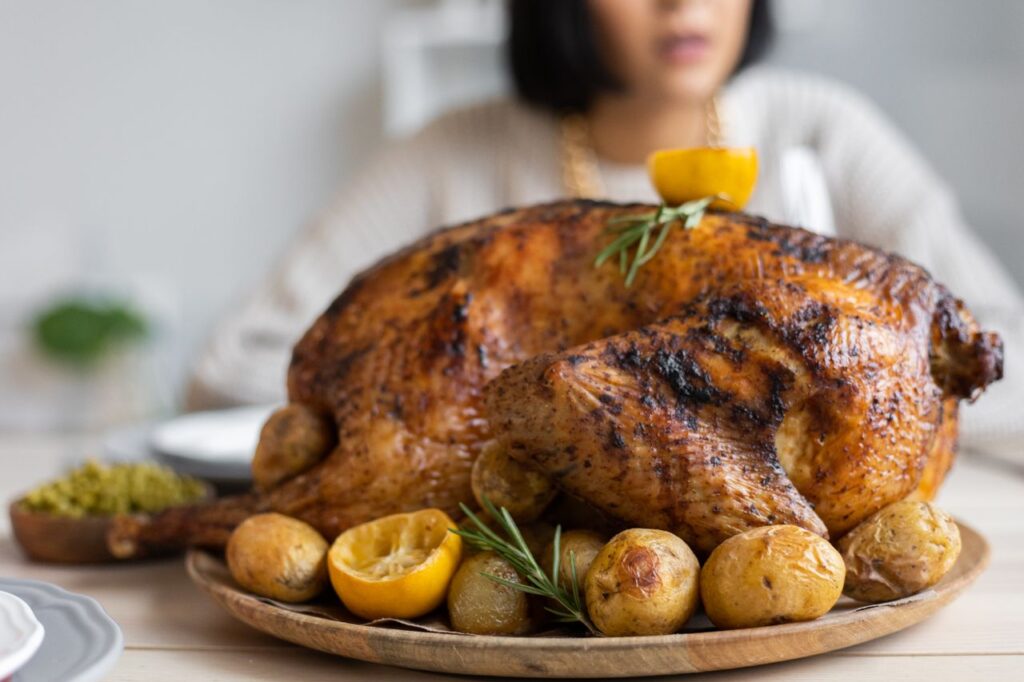
Yes. Plain turkey is safe for dogs.
A small piece of plain, fully cooked, boneless, skinless turkey won’t hurt a healthy dog. That’s the short answer to “can dogs eat turkey,” and it’s the one the American Kennel Club gives too: turkey meat itself is not toxic to dogs.
But that’s the turkey on your dog’s plate. The turkey on your plate is a different animal. By the time it reaches the table, it’s usually wrapped in skin, basted in butter, rubbed with seasoning, and sitting in a pool of gravy. Every one of those extras is a problem, and one of them — the skin — is the scrap that sends the most dogs to the emergency vet over Thanksgiving weekend.
So the real question isn’t whether dogs can eat turkey. It’s which part of the bird your dog just got, and how much of it.
Can dogs eat turkey?
Yes, if it’s plain. That word does a lot of heavy lifting, so let’s pin it down. Plain means white meat, fully cooked, with the skin off, the bones out, and nothing added. No butter, no oil, no salt rub, no garlic, no onion, no gravy poured over the top.
The AKC’s position is straightforward: cooked turkey meat is safe for dogs, the white meat is leaner than the dark, and you should remove the excess fat, the skin, and all the bones. Turkey is a common ingredient in dog food for a reason — it’s lean protein, with riboflavin and phosphorus in the mix. That doesn’t make it a health food your dog needs. A dog eating a complete, balanced diet already gets what it needs, so think of turkey as a harmless holiday treat, not a nutritional upgrade. Nobody should be feeding their dog turkey for the vitamins.
The risk with turkey was never the bird. It’s the preparation. A butter-brined bird is not plain turkey. A bird rubbed with garlic and onion is not plain turkey. The skin your dog is begging for is not plain turkey either. Keep the meat plain, keep the portion small, and the answer stays yes.
Which parts of the Thanksgiving turkey can dogs eat?
Here’s the whole plate, dish by dish, because this is where most articles wave their hands and say “be careful.” When someone asks can dogs eat turkey at Thanksgiving, this table is the answer — not a yes or no, but a which-part answer. Let’s be specific instead.
| What’s on the plate | Safe for dogs? | Why |
|---|---|---|
| Plain white breast meat, no skin | Yes, small portion | Lean, fully cooked, nothing added — the only share |
| Plain dark meat, no skin | Yes, smaller portion | Safe but fattier than breast, so less of it |
| Turkey skin | No, never | Concentrated fat, usually basted in butter or oil — a pancreatitis trigger |
| Pan drippings and gravy | No | Fatty and salty, and it carries the seasoning from the bird |
| Cooked turkey bones | No, never | Dry and brittle, they splinter into sharp shards |
| Stuffing | No | Onion, garlic, butter and salt — three separate problems in one spoonful |
| Butter-basted or brined bird | No, not as a share | The butter and salt soak into the meat, so it’s no longer plain |
| Raw or undercooked turkey | No | Salmonella, campylobacter, E. coli and listeria |
That table is the whole article in miniature. If you only remember one row, remember the skin. The meat is fine. The skin is the problem.
Why turkey skin is the real problem
Turkey skin is mostly fat, and at Thanksgiving it’s fat that has spent hours basted in butter or oil and covered in seasoning. For a dog, that’s a pancreatitis risk, and pancreatitis is not a mild stomach upset. It’s a painful inflammation of the pancreas that can turn into a vet emergency.
Now, the two big authorities don’t quite say the same thing here, and it’s worth being honest about that instead of picking the version that sounds nicer. The AKC says a small portion of plain, carefully prepared turkey is fine for most healthy dogs. The AVMA goes further: it warns that eating turkey or turkey skin, even in small amounts, can bring on life-threatening pancreatitis in pets, and it suggests a pet-specific treat instead of sharing the feast at all.
Both are right, and they point to the same practical answer. The AKC is talking about plain meat. The AVMA is talking about the feast — the skin, the fat, the rich scraps. So the conservative line this guide takes is simple: plain meat in a small portion is the only share, and skin is never the share, not even a “small taste.” The AVMA’s warning is exactly why that line is drawn there.
If your dog has already eaten skin, don’t wait for a dramatic symptom. Pet Poison Helpline’s Thanksgiving guidance says the signs of a fatty meal — vomiting, diarrhea, loss of appetite, belly pain — may not show up right away, so watch your dog closely after an exposure. And if the signs do show up, that’s a vet call, not a wait-and-see. A dog that has had pancreatitis before, or has diabetes, kidney disease, or a food allergy, shouldn’t be getting turkey at all without their vet saying so first.
How much turkey can a dog eat?
Here’s where the guides disagree, so let’s be straight about it. The question behind “can dogs eat turkey” is really two questions: is the meat safe, and how much is too much? The answer to the first one is settled. The answer to the second one isn’t, and any article that prints one number as settled science is guessing.
Chewy’s portion table says an extra-small dog (2 to 10 pounds) gets half an ounce, a small dog (11 to 20 pounds) gets one ounce, a medium dog (21 to 50 pounds) gets two ounces, a large dog (51 to 90 pounds) gets two and a half ounces, and an extra-large dog (91 pounds and up) gets three ounces. PetMD says a 25-pound dog can have about one and a half ounces of plain, skinless white turkey as an occasional treat. Those two roughly agree. DogSafeBites goes further, suggesting up to half a cup for a large dog, which is the generous outlier. So this table takes the conservative side of that range — Chewy and PetMD, not the outlier.
| Dog size | Weight | Plain white turkey, once in a while |
|---|---|---|
| Extra small | 2 to 10 lb | 1/2 oz (about 1 tablespoon shredded) |
| Small | 11 to 20 lb | 1 oz (about 2 tablespoons shredded) |
| Medium | 21 to 50 lb | 1 1/2 oz (about 3 tablespoons shredded) |
| Large | 51 to 90 lb | 2 oz (about 1/4 cup shredded) |
| Extra large | 91 lb and up | 2 1/2 to 3 oz (about 1/3 cup shredded) |
Three rules sit behind those numbers. First, treats stay inside the 10% rule: treats of any kind should stay under 10% of what your dog eats in a day. The AKC, PetMD and Chewy all agree on that one. Second, “once in a while” means what it says — turkey is an occasional treat, not a daily topper. Third, these are maximums for a healthy adult dog, not a target to hit. A spoonful less is always fine. And a dog with pancreatitis, diabetes, kidney disease or a sensitive stomach doesn’t get a portion at all unless their vet approves it.
One more thing the portion tables never mention: don’t let three different people each give the dog “just a little.” At a full Thanksgiving table, the dog that got a careful tablespoon from you may also have got a careful tablespoon from your aunt, your cousin, and your dad. That’s four portions. If you’re sharing turkey, one person does the sharing, and everyone else keeps their hands in their pockets.
Can dogs eat turkey bones?
No. Cooked turkey bones are never safe for dogs, and this is the one rule with no exceptions and no portion size. It’s the part of “can dogs eat turkey” that has no grey area at all.
Cooking makes poultry bones dry and brittle, so they splinter instead of breaking cleanly. The sharp shards can cut the mouth, get stuck in the throat, block the intestines, or puncture the gut. The AKC is blunt about it: never give a dog cooked poultry bones, because they splinter and create a veterinary emergency. The ASPCA and VCA say the same, and the AVMA lists cooked bones among the holiday hazards that cause choking or intestinal blockage.
Raw bones aren’t the answer either. They carry salmonella, and a raw turkey bone is still a choking and blockage risk for a dog that gulps. The carcass belongs in a lidded bin or an outdoor can the moment the meal is over, not in a trash bag on the floor where a determined dog can get at it.
If your dog already swallowed a bone, don’t try to fix it at home. Move the dog away from any remaining bones and call your vet right away. Don’t try to make your dog vomit — a sharp shard can do more damage coming back up, and Pet Poison Helpline says never to induce vomiting at home without a vet telling you to. The numbers, in case you need them in a hurry: ASPCA Animal Poison Control (888) 426-4435, Pet Poison Helpline (855) 764-7661. Both are staffed around the clock, including Thanksgiving Day.
Can dogs eat raw turkey?
No. Raw or undercooked turkey can carry salmonella, campylobacter, E. coli and listeria, and dogs are not immune to food poisoning just because they eat raw food sometimes. Raw turkey changes the answer to can dogs eat turkey completely — it goes from a careful yes to a flat no. The ASPCA’s rule is simple: any turkey you share should be boneless and fully cooked.
Fully cooked means the meat has reached 165°F all the way through, measured with a food thermometer in the thickest part of the breast, the innermost part of the thigh, and the innermost part of the wing. That’s the USDA’s safe minimum internal temperature for turkey, and it’s the number that kills the bacteria that cause food poisoning. If you’re carving the bird and the meat near the bone is still pink, it’s not done, and it’s not for the dog either.
The same rule covers the trimmings. Don’t let the dog lick the raw turkey platter, don’t toss them the raw neck or giblets while you’re prepping, and wash your hands before you hand them anything after handling raw poultry.
What about ground turkey, deli turkey and giblets?
Ground turkey is fine if it’s plain and fully cooked through — same rules as the whole bird, no seasoning, no skin, no fat left in. If you’re asking can dogs eat turkey in its ground form, the answer is the same yes, and it’s actually one of the easier ways to give a dog a measured portion, because you can weigh out an ounce and be done with it.
Deli turkey is a different story. The sliced turkey from the deli counter is salty, it’s usually seasoned, and it often contains nitrates and other preservatives. It’s not toxic in the way grapes are toxic, but it’s a poor treat — too much salt, too many additives, and no reason to choose it over plain cooked turkey. Skip it.
Giblets — the heart, liver and gizzard that come tucked inside the bird — are safe occasionally, cooked through, in small amounts. They’re rich, so a little goes a long way, and they should never be served raw. The neck is not worth it: it’s mostly bone, and cooked neck bones splinter like any other cooked poultry bone.
What if my dog already ate turkey skin or a bone?
Work through it in this order.
First, what exactly did they eat, and how much? A single bite of plain breast meat needs nothing more than a mental note. A mouthful of skin, a ladle of gravy, or a plate of drippings is a watch-closely situation. A cooked bone is a call-your-vet situation, right away, even if your dog seems fine.
Second, watch for the signs. Vomiting, diarrhea, loss of appetite and belly pain are the signs Pet Poison Helpline lists for a fatty meal, and they may not show up right away. A dog that is hunched, restless, or refusing food the morning after Thanksgiving is telling you something. Repeated vomiting, a painful belly, or unusual lethargy after a holiday meal means the vet, immediately, not tomorrow morning.
Third, keep the evidence. If you call your vet or a poison line, they’ll want to know what your dog ate and how much. A photo of the plate or the packaging is enough, and it saves you trying to remember the recipe while you’re worried.
The numbers again, because they matter in a hurry: ASPCA Animal Poison Control (888) 426-4435, Pet Poison Helpline (855) 764-7661. Both lines are open 24 hours a day, including Thanksgiving. A consultation fee may apply, and it’s worth every cent when the alternative is guessing.
What about the rest of the Thanksgiving table?
Turkey is one plate on a crowded table, and the same plain-and-small rule decides the rest of it. Our Thanksgiving foods guide covers the full spread — what’s safe and what isn’t — so this article doesn’t have to repeat it. And if the meal is already over and you’re staring at the fridge, our Thanksgiving leftovers guide takes it from there: what’s still safe on day two and three, and what goes straight in the bin.
The foods that work alongside turkey are the plain, unseasoned ones: a little plain chicken with no skin and no seasoning, some carrots from the veg tray, a few cranberries if they’re fresh and plain — not the sauce. The ones that don’t work are the same ones that ruin the turkey: stuffing with onion and garlic, buttery mashed potatoes, anything with gravy on it, and anything sweetened with xylitol. Grapes and raisins are never safe, in any amount, at any meal.
The pattern is the same every time, and turkey follows it exactly. Plain food, small portion, nothing added. That’s the whole rule. Everything else is just working out what “plain” means for each food on the table.
Questions people ask about dogs and turkey
Can dogs eat turkey skin? No, not even a small taste. Turkey skin is concentrated fat, usually basted in butter or oil, and the AVMA warns that eating turkey or turkey skin, even in small amounts, can cause life-threatening pancreatitis. The AKC’s chief veterinarian, Dr. Klein, advises skipping the skin entirely. It’s the one part of the bird that is never worth sharing.
Can dogs eat turkey bones? No. Cooked turkey bones splinter into sharp shards that can choke a dog, block the intestines, or puncture the gut. Raw bones carry salmonella and are still a choking risk. If your dog swallowed a bone, call your vet right away.
How much turkey can a dog eat? A small portion of plain, boneless, skinless white meat, once in a while, inside the 10% treats rule. As a rough guide: half an ounce for an extra-small dog, one ounce for a small dog, one and a half ounces for a medium dog, two ounces for a large dog, and up to three ounces for an extra-large dog. The guides disagree on exact numbers, so this table takes the conservative side — Chewy and PetMD, not the most generous figure out there.
Can puppies eat turkey? A small piece of plain, fully cooked, boneless, skinless turkey is fine for most puppies, cut small. Keep the portion tiny — a puppy’s stomach is less forgiving than an adult dog’s — and skip it entirely if your puppy is very young or has a sensitive stomach. Your vet can give you the exact answer for your puppy.
Is dark meat or white meat better for dogs? White meat. Breast meat is leaner than thigh or leg meat, so it’s the safer share. Dark meat isn’t toxic, but it’s fattier, so the portion should be smaller. Either way, the skin stays off and the seasoning stays out.
So, can dogs eat turkey? Yes — plain white meat, a small portion, once in a while. The bird itself was never the problem. It’s the skin, the bones, the butter, the gravy and the seasoning that turn a safe treat into a vet visit. Keep it plain, and the answer stays yes.