
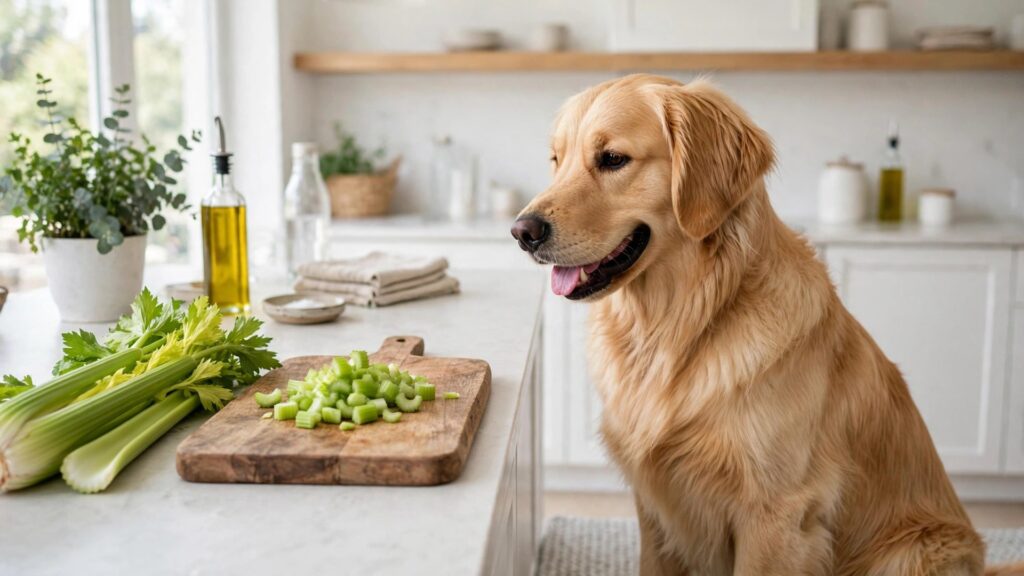
Yes, dogs can eat celery, in small pieces, served plain, with the strings peeled off.
That is the short answer to can dogs eat celery, and it comes with a twist most articles skip. The celery itself is not the problem. No toxin hides in it, and it sits nowhere on the ASPCA avoid list. The problem is the shape it arrives in. A whole celery stick is a long, tough, stringy length of fiber, and that shape can choke a small dog or block a gut. Cut it into small pieces, peel the strings away, and the same stalk turns into one of the best low-calorie treats in your fridge.
So can dogs eat celery off your cutting board? Yes, a few small plain pieces, a few times a week. Wash it first, peel the strings, cut it no bigger than their kibble, and skip anything that came out of a pot with onion or garlic in it. That is the whole deal.
Key takeaways
- Yes, dogs can eat celery, plain, raw or lightly cooked, in small pieces, a few times a week.
- Celery is not toxic to dogs. The real risks are choking on the strings, stomach upset from too much fiber, and sodium for dogs on a restricted diet.
- Keep celery inside the 10% treat rule: treats of every kind together stay under 10% of daily calories.
- Always peel the strings and cut celery into bite-size pieces, about a quarter inch thick. A whole stick can choke a dog or block the gut.
- One medium stalk carries only about 6 to 10 calories and about 32 mg of sodium, and it is roughly 95% water.
- Skip celery for dogs with a history of kidney or bladder stones. Celery contains oxalates, which can make stone formation worse.
- The leaves hold the most calcium, potassium and vitamin C in the plant, but also the most pesticides, so wash them well or cut them off.
- First time? One small piece, then watch for 24 hours before offering more.
Is celery good for dogs?
Ask a vet can dogs eat celery and you will get a yes, and a happier yes than most vegetables earn. The American Kennel Club calls celery generally safe, naturally low in fat and cholesterol, and a satisfying treat for dogs that need to lose weight. PetMD goes further and calls it very healthy for dogs. Both agree on the reason: celery gives a dog a lot of crunch and nutrition for almost no calories.
Here is what is in it. The AKC lists fiber, vitamins A, C and K, folate, potassium and manganese. A medium stalk runs about 6 to 10 calories, and a cup of chopped celery runs about 16 calories. It is roughly 95% water, so it hydrates on a hot day and fills a hungry dog up without filling the calorie budget. For a dog on a diet, that combination is hard to beat. A biscuit with the same crunch costs ten times the calories and does nothing for hydration.
The crunch does one more quiet job. The AKC notes that celery’s crunchy texture may help freshen a dog’s breath, and other vet guides point out that the crisp stalk can scrub a little plaque off the teeth while a dog chews it. It is not a toothbrush, and it will not replace dental care, but as treats go, it is one of the few that helps the mouth instead of hurting it.
But celery is a treat, not a meal. It does not replace kibble, and it does not need to. Their regular food is already complete. The celery is the bonus on top, and if it starts crowding out their normal food instead of topping it, they are quietly losing nutrition while you think you are feeding them better.
The strings are the risk
Here is the part that matters most, and it is the part most articles bury under the nutrition list.
Celery is safe. The strings are not. A celery stalk is built out of long, tough fibers that run its full length, and a dog that gulps a whole stick swallows a length of string that does not break apart easily. PetMD says it plainly: a whole celery stick could become a choking hazard or even lead to an intestinal blockage. The AKC says the same thing in different words, and flags small dogs in particular.
The fix takes about thirty seconds, and it removes the one real physical danger in this vegetable. Wash the stalk, then peel the tough strings off the back, the same way you would peel a banana. Then cut what is left into bite-size pieces, about a quarter inch thick, no bigger than your dog’s kibble. Petful’s vet guide adds a simple check: if you can squash a piece flat between your thumb and forefinger without much effort, it is small enough for most dogs. For toy breeds and puppies, cut even smaller and always supervise.
That is also why cooked celery can be easier for some dogs. Steaming or boiling softens the fibers, so a cooked piece breaks apart instead of holding its shape. Plain cooked celery is fine, as long as it was cooked in water and nothing else. The moment butter, salt, or a stock cube joins the pot, it stops being plain, and the next section explains why that matters.
How much celery can my dog have?
This is where most articles on can dogs eat celery trip over themselves, because the best sources give their portions in different units. PetMD counts in pieces, Petful counts in quarter-inch slices, and another vet-reviewed guide counts in teaspoons and cups, and nobody puts them together. The table below does. It uses PetMD’s piece counts as the base, adds the spoon amounts alongside, and stays inside the 10% rule throughout.
| Dog size | Weight | Celery per serving | How often |
|---|---|---|---|
| Extra-small | 2-10 lbs | 1-2 small pieces, about 1-2 teaspoons | 2-3 times a week |
| Small | 11-25 lbs | 2-3 pieces, about 1 tablespoon | 2-3 times a week |
| Medium | 26-50 lbs | 5-6 pieces, about 2 tablespoons | A few times a week |
| Large | 51-90 lbs | A small handful, about 1/4 cup | A few times a week |
| Extra-large | 91+ lbs | A handful, about 1/3 cup | A few times a week |
A quick reality check on those numbers: a single stalk is only about 6 to 10 calories, so the calories almost never set the limit here. What sets the limit is fiber and the shape of the pieces. A dog that eats a whole head of celery will not be poisoned, but it will very likely spend the evening with gas, loose stools, and a sore stomach. Too much fiber does that, and celery is mostly fiber and water.
The 10% rule is the same one that governs every treat. Treats and toppers together should stay under 10% of your dog’s daily calories, and the other 90% should come from their complete food. With celery, that ceiling is almost impossible to reach by calories alone, which is exactly why it works so well as a weight-loss treat. PetMD makes the same point for dogs on a vet-prescribed weight-loss diet: a few pieces of celery can keep a begging dog happy without breaking the diet, as long as the vet says it is fine.
One number worth knowing is sodium. A medium stalk carries about 32 mg of sodium, which is high for a vegetable. A few pieces are a small fraction of that, so a healthy dog has nothing to worry about. But if your vet has your dog on a low-sodium diet for a heart or kidney condition, ask first. The sodium is the one quiet reason celery is not a free-for-all, even though the calories are.
First time? Give one small piece and wait 24 hours. If their stomach stays calm and their poop looks normal, move up to the portion above. And count the celery in the 10% budget, not on top of a full bowl plus the usual treats.
The leaves paradox
Celery leaves are the most misunderstood part of the plant, and they hold a small paradox of their own.
PetMD notes that the leaves are easy for dogs to digest and contain the most calcium, potassium and vitamin C in the whole plant. By nutrition alone, the leaves are the best part. But the leaves are also where the most pesticides sit, so PetMD’s advice is to remove and discard them before serving. Conventional celery sits on the EWG Dirty Dozen list, which is another reason to wash every stalk well under running water before it goes near your dog.
So what should you do with the leaves? If the celery is organic and you have washed it well, a few leaves mixed into the pieces are fine. If it is conventional celery, or you are not sure how well it was washed, cut the leaves off and throw them away. You lose a little nutrition and remove the whole pesticide question, and the stalk itself still gives your dog everything it needs from this vegetable.
Can dogs eat raw celery?
Yes, raw celery is fine, as long as it is washed, peeled, and cut small. Raw keeps the crunch, and dogs that like to chew tend to enjoy it. The same 10% limit applies. Raw does not change anything about the safety math, and most vet guides treat raw as the default way to serve it.
Lightly steamed or boiled is the gentlest form, and it is the one to pick for a first feed or for a small dog. Cooking softens the fibers, which takes the choking risk down further, and it does not add anything to the bowl. Just let it cool before serving. A hot piece straight out of the pot is a burned mouth.
Frozen celery is also fine, and a frozen piece makes a good chew on a hot day. PetMD notes that freezing costs the celery most of its nutrients, so a frozen piece is more of a cool-down toy than a nutritious treat. Supervise it like any chew, and do not let a small dog work on a piece big enough to swallow whole.
What never works is seasoned celery. Celery from your dinner usually arrives with butter, salt, or a seasoning blend, and seasoning blends often hide garlic or onion powder. Garlic and onion are toxic to dogs in every form, raw, cooked, or powdered. The celery underneath is fine. Everything on top of it is the problem. Cook a plain piece just for them, or pick out plain pieces before the seasoning goes on.
Two kitchen traps deserve a name. The first is the stock pot. Celery in soup or stock almost always travels with onion and garlic, so celery that came out of a soup is not plain celery, even if you fish it out. The second is ants on a log, celery with peanut butter and raisins. Raisins are toxic to dogs, and some peanut butters carry xylitol, which is also toxic. Plain celery with a smear of xylitol-free peanut butter is a different thing, but the classic snack as served is not safe.
Who should skip celery?
For most dogs the answer to can dogs eat celery is a yes. But a few dogs should skip it entirely, and the reasons are specific.
Dogs with kidney or bladder stones. This is the one clear skip. Celery contains oxalates, and oxalates can make stone formation worse in dogs that are already prone to them. Petful’s vet guide says to skip celery entirely for dogs with a history of kidney or bladder stones, and other vet guides agree. If your dog has ever passed a stone, or your vet has flagged crystals in the urine, leave celery out and ask your vet for a safer crunchy treat.
Puppies. A tiny taste is fine once a puppy is on solid food, plain, soft, and cut very small. Keep the portion at the bottom of the table and watch their stomach for a day before giving more. Puppies have smaller airways and smaller guts, so the choking rule matters twice as much for them, and the first feed should be one piece, not a serving.
Seniors. Older dogs can eat celery the same way younger dogs can, but two things change. Their digestion is often more sensitive, so gas and loose stools show up faster. And if they are on a prescription diet or medication, check with the vet first. The diet was prescribed for a reason, and extras can interfere with it.
Dogs on prescription diets. Same rule as seniors, check first. PetMD flags this one explicitly. A prescription diet is doing a job, and unplanned extras can undo it, even healthy ones.
Dogs with sensitive stomachs. If your dog has a history of gut trouble, introduce celery one piece at a time and watch for a day. The same fiber that helps a healthy dog can set off a real flare in a dog whose gut is already irritated. The AKC’s Dr. Jerry Klein gives the same advice for every new food: introduce it slowly and watch what happens.
Easy ways to serve celery to your dog
Once you have answered can dogs eat celery with a yes in your own kitchen, here are the servings that actually work:
- Crunchy topper. A few raw pieces, peeled and cut small, over their regular kibble. It sits nicely next to other safe foods. Our eggs guide and chicken guide cover two more easy ones, and our broccoli guide shows the same plain-and-small rules on another vegetable.
- Training reward. One small piece as a reward is a training treat with almost no calories. Dogs that work for food will work for celery, and you can train longer without filling them up.
- Weight-loss swap. Replace a biscuit with a few celery pieces. Same crunch, a tenth of the calories, and a fuller-feeling dog. PetMD points to this exact swap for dogs on a weight-loss plan.
- Frozen chew. A frozen piece on a hot day doubles as a chew and a cool-down. Supervise it like any chew. Once it thaws and softens, it is just a piece of celery again.
- Veggie bowl mix. A little chopped celery mixed with plain steamed carrots or green beans turns a boring bowl into dinner. If you are cooking a holiday meal, the same plain rule applies. Our Thanksgiving foods guide covers what is safe on the table and what is not.
- Lick-mat mash. Mash steamed celery with a little plain pumpkin puree and smear it on a lick mat. Slow, calming, and great for a dog who inhales food.
Fresh celery keeps in the fridge for about two weeks if you keep it dry and wrapped. Cut pieces keep three to four days in a sealed container. After that, toss them. A limp piece from the back of the fridge is not a treat anymore. And if you are wondering what else from the produce drawer is safe, our apples guide and bananas guide cover two more everyday foods the same way.
What if my dog ate too much celery?
First, do not panic, but do not wait and hope either. A dog that ate a few extra pieces will most likely just be gassy and uncomfortable for a day. A dog that gulped a whole stalk, or a bunch of long stringy pieces, is a different story, because the risk there is a blockage, not a toxin.
Watch for repeated vomiting, gagging, bloating, diarrhea that will not stop, lethargy, or a painful belly. If your dog is straining, drooling, or pawing at its mouth, a piece may be stuck. That is a vet visit right away, not a wait-and-see. If your dog is a puppy, elderly, or already dealing with health problems, call sooner rather than later.
Call your vet and tell them what happened: how much celery, raw or cooked, and when they ate it. If you cannot reach your vet, the ASPCA Animal Poison Control Center is at (888) 426-4435, and the Pet Poison Helpline is at (855) 764-7661. Both are worth saving in your phone before you need them.
Do not try to make your dog vomit. That can cause more damage on the way back up, especially if a stringy piece is involved. Keep them calm, keep water available, and let the vet decide what comes next.
Can dogs eat celery: questions owners actually ask
Can dogs eat celery every day?
A few times a week is better than every day. The 10% rule still applies daily, but celery’s fiber effect builds up with frequency. A daily serving is more likely to mean a daily gassy dog, and there is no nutritional reason to serve it daily. Two or three times a week is the sweet spot.
Can dogs eat celery leaves?
Yes, in small amounts, if they are washed well. The leaves hold the most calcium, potassium and vitamin C in the plant. But they also hold the most pesticides, so if the celery is not organic, cut the leaves off and throw them away.
Can dogs eat cooked celery?
Yes, lightly steamed or boiled, plain, and cooled. Cooking softens the fibers and makes the pieces easier to chew. Just keep it out of any pot that held onion, garlic, butter, or salt.
Can dogs eat celery sticks whole?
No. A whole stick is the one form you should never serve. The long strings can choke a dog or block the gut. Always peel the strings and cut the stalk into bite-size pieces first.
Can puppies eat celery?
Yes, a tiny taste once they are on solid food, plain, soft, and cut very small. One piece first, then watch for a day. Puppies have smaller airways, so the cut-small rule matters even more for them.
Can dogs eat celery with peanut butter?
Only if the peanut butter is xylitol-free and plain, and only a thin smear. Some peanut butters carry xylitol, which is toxic to dogs, so check the label every time. And skip ants on a log entirely, because the raisins in it are toxic.
So, can dogs eat celery?
Yes, can dogs eat celery? Plain yes, small yes, strings out always. A few plain pieces, peeled and cut no bigger than their kibble, a few times a week, inside the portion table. That is the entire playbook, and it is one of the easiest wins in your kitchen: a treat your dog crunches happily, that you probably already have in the fridge, with nothing to buy and nothing complicated to remember. And if you want another easy one next, broccoli works the same way, plain, small, and a few times a week, as our broccoli guide shows.