
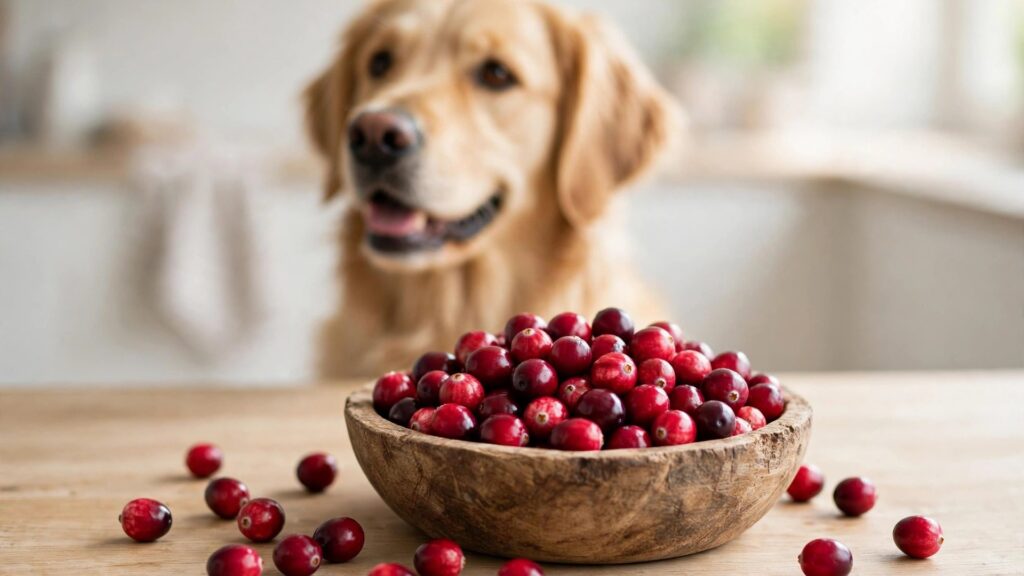
Yes. Plain cranberries are safe for dogs.
A few fresh or cooked berries, with nothing added, won’t hurt your dog. That’s the short answer to “can dogs eat cranberries,” and it’s the one the American Kennel Club gives too: plain cranberries are not toxic to dogs.
But that’s the plain berry. What most dogs actually meet at Thanksgiving is cranberry sauce, sweetened dried cranberries, or a handful of trail mix knocked off the table. Those are three very different stories, and one of them can land your dog at the emergency vet.
So the real question isn’t whether cranberries are safe. It’s which form your dog just ate, and how much.
Can dogs eat cranberries?
Yes, in small amounts, plain. Fresh or cooked, it doesn’t matter much — what matters is that nothing was added to them. No sugar, no sweetener, no other fruit mixed in.
Cranberries carry vitamin C, antioxidants, and compounds called proanthocyanidins. That sounds impressive, and it is — for people. For your dog, it doesn’t change much. A dog eating a complete, balanced diet already gets what it needs, so think of cranberries as a harmless treat, not a health food. Nobody should be feeding their dog cranberries for the vitamins.
The tartness does half the portion control for you. Most dogs take a few berries, pull a face, and walk away. That’s a natural limit, not a safety guarantee — a determined dog will still eat a whole bowl if you leave one on the floor.
Two things to get right every time: keep the portion small, and keep the berries plain. Everything else in this guide is about what happens when one of those two rules breaks.
How many cranberries can a dog eat?
Here’s where the guides disagree, so let’s be straight about it. The question behind “can dogs eat cranberries” is really two questions: is the berry itself safe, and how much is too much? The AKC doesn’t give a number at all. A vet-reviewed guide, Genghis Collar, gives a handful — about 10 to 15 berries — for a medium to large dog, and 3 to 5 for a small dog. Other guides just say “a few.” There is no settled science here, so this table takes the conservative side of that range.
| Dog size | Weight | Fresh cranberries, once in a while |
|---|---|---|
| Small | Under 20 lb | 3 to 5 berries, cut in half |
| Medium | 20 to 50 lb | 5 to 10 berries |
| Large | Over 50 lb | Up to 10 to 15 berries |
Three rules sit behind those numbers. First, treats stay inside the 10% rule: treats of any kind should stay under 10% of what your dog eats in a day. The AKC, PetMD and UC Davis all agree on that one. Second, “once in a while” means what it says — cranberries are an occasional treat, not a daily topper. Third, too many at once will upset your dog’s stomach, even when the berries are perfectly plain. Loose stools are the usual result, and that’s your dog telling you the portion was too big.
Cut the berries in half for small dogs. Whole cranberries are round, firm, and just about the size to get stuck, and small dogs are the ones who gulp. It’s a thirty-second job and it takes the choking risk off the table.
Can dogs eat cranberry sauce?
This is the one that matters at Thanksgiving, so let’s take it slowly.
Canned cranberry sauce is mostly sugar. A dog that licks a bit of plain sauce off a plate will probably be fine. A dog fed a spoonful of it gets a sugar hit its stomach didn’t ask for, and a dog that eats the whole can has a real problem.
The AKC puts it carefully: cranberry sauce is high in sugar and may be safe only in minute quantities. SpotPet and the Canine Bible are blunter — in general, don’t feed it to your dog at all. Both are right. A lick and a serving are not the same thing, and the line between them is thinner than most people think.
Homemade sauce is where it gets genuinely dangerous, because the recipe is a mystery. Some recipes add grapes, raisins, or currants. Grapes and raisins are toxic to dogs — a small amount can cause kidney failure, and there is no safe dose. Some recipes add brandy or another alcohol. Alcohol is toxic to dogs too. If you didn’t make the sauce yourself, assume you don’t know what’s in it, and keep the dog away from it.
If your dog already ate some sauce, don’t panic, but do check two things right now: how much, and what was in it. A lick of plain canned sauce needs watching, not a vet visit. A bowl of homemade sauce with unknown ingredients needs a call to your vet. If you ever need the number in a hurry, it’s ASPCA Animal Poison Control at (888) 426-4435 or Pet Poison Helpline at (855) 764-7661. Both lines are open around the clock.
For the full Thanksgiving table — turkey, stuffing, and everything else your dog will beg for — our Thanksgiving foods guide covers what’s safe and what isn’t, so this article doesn’t have to repeat it.
Can dogs eat dried cranberries?
Only if they’re plain and unsweetened, and most of the ones in shops aren’t.
The bagged dried cranberries most of us buy — the ones sold as Craisins and their lookalikes — are sweetened. Some are sweetened with sugar, which makes them a bad treat. Some sugar-free versions are sweetened with xylitol instead, and xylitol is an emergency for dogs. A dose of just 0.1 grams per kilogram of body weight can crash a dog’s blood sugar within 10 to 60 minutes, according to Pet Poison Helpline, and liver damage becomes a risk above 0.5 grams per kilogram. For a 20-pound dog, that’s less than a gram of xylitol — about what one piece of high-xylitol gum can carry.
So the rule for dried cranberries is simple: read the label before the dog eats any. If the ingredients list only cranberries, a few are fine. If it lists sugar, they’re a poor treat. If it lists xylitol or birch sugar, they don’t go anywhere near your dog — and if your dog already ate some, call your vet right away.
Trail mix is out completely, whatever the label says. Dried cranberries in trail mix almost always sit next to raisins, and raisins are toxic to dogs. A handful of trail mix is a raisin problem wearing a cranberry disguise. Same goes for granola bars, cookies, and baked goods with dried cranberries in them: the berry is the least of it. It’s the raisins, the xylitol, the chocolate, and the macadamia nuts hiding next to it that do the damage.
Can dogs drink cranberry juice?
No. Not the cocktail, not the juice drink, not the “100% juice” bottle either.
Cranberry juice cocktail — the sweet red bottle in most fridges — is mostly sugar water with a little cranberry in it. The sugar-free versions are worse: many use xylitol, and you’ve just read what that does. The AKC also warns about grape and cranberry juice blends, because grape juice carries the same kidney risk as whole grapes.
Even unsweetened, pure cranberry juice is a bad idea for a dog. It’s concentrated, it’s very tart, and it delivers far more cranberry in one bowl than a dog would ever eat as whole berries. Water is what your dog needs. Juice is a human drink, and it should stay that way.
What if my dog ate cranberry sauce or trail mix?
Work through it in this order.
First, what exactly did they eat? A lick of plain canned sauce is a watch-and-wait situation. A spoonful of homemade sauce with unknown ingredients is a call-your-vet situation. A handful of trail mix, or anything with xylitol in it, is a call-your-vet-right-now situation — don’t wait for symptoms.
Second, watch for the signs. Vomiting, wobbling, weakness, or acting drunk within an hour points to a blood sugar crash, which is what xylitol does. Vomiting that starts a day or two later, along with yellowing gums or unusual tiredness, points to liver damage. Grape and raisin poisoning often starts with vomiting too, then the dog stops eating and drinking, and the kidneys can fail over the next day or two. Any of that means the vet, immediately, not tomorrow morning.
Third, keep the packaging. If you call the vet or a poison line, they’ll want the ingredient list and how much your dog ate. A photo of the label is enough.
The numbers again, because they matter in a hurry: ASPCA Animal Poison Control (888) 426-4435, Pet Poison Helpline (855) 764-7661. Both are staffed 24 hours a day. A consultation fee may apply, and it’s worth every cent when the alternative is guessing.
Do cranberries help with UTIs in dogs?
This is the claim you’ll see on supplement bottles and in half the articles about cranberries, and the honest answer is: we don’t know, and the best evidence we have leans toward no.
The AKC says cranberry has not been proven to prevent or treat urinary tract infections in dogs. A systematic review published in 2026 in the Journal of Veterinary Pharmacology and Therapeutics — Weese and Weese — pulled together every study on cranberry for urinary infections in dogs and cats. There were only three, covering 122 animals in total: 106 dogs and 16 cats. None of them showed a significant benefit, and the reviewers rated the certainty of the evidence as low to very low. Their conclusion was plain: the data can’t support cranberry as a treatment or a preventive, and it can’t rule it out either. There just isn’t enough good research.
So if your dog has urinary symptoms — straining, blood in the urine, going out every twenty minutes — the answer is a vet visit and a urine test, not a handful of berries. Cranberry supplements are not a replacement for antibiotics when an infection is really there.
There’s a second reason not to overdo cranberries. Veterinarian Dr. Marie Haynes warns, via the AKC, that large amounts of cranberries can lead to calcium oxalate stones in the bladder. That’s a warning about large amounts, not about a few berries. But if your dog has already had bladder stones, or has a history of calcium oxalate stones, ask your vet before cranberries become a regular treat.
How to serve cranberries to your dog
Keep it boring. That’s the whole trick.
Wash a few fresh berries, cut them in half if your dog is small, and hand them over as a treat or stir them into dinner. Cooked is fine too — plain cranberries simmered in a little water, no sugar, no spices, cooled before serving. Frozen berries make a crunchy treat on a hot day, and the cold slows most dogs down enough to chew.
What not to do: don’t buy the sweetened bag and pick the sugar off in your head, don’t mix them into trail mix, and don’t pour juice over kibble thinking it’s the same thing. The berry is safe. The company it keeps is usually what causes the trouble.
Dogs who should skip cranberries or check with the vet first: any dog with a history of bladder stones, any dog on blood-thinning medication — cranberry is known to interact with warfarin in people, and vets take the same precaution with dogs — and any dog with a sensitive stomach. For the sensitive ones, start with one or two berries and see how the next day goes.
What about the rest of the Thanksgiving table?
Cranberries are one small part of the holiday. If you’re planning what your dog can share from the table, the plain, unseasoned foods are the ones that work: a little plain chicken with no skin and no seasoning, some broccoli or carrots or celery from the veg tray, a spoonful of plain pumpkin if you have it. Eggs are fine too, cooked plain.
The fruits are where people get tripped up. Apples are fine without the core and seeds, bananas are fine in small pieces, mango is fine without the pit and skin, and pineapple is fine in small chunks if you skip the core and watch the acid. Grapes and raisins are the ones that aren’t — ever, in any amount.
The pattern is the same every time, and cranberries follow it exactly. Plain food, small portion, nothing added. That’s the whole rule. Everything else is just working out what “plain” means for each food on the table.
Questions people ask about dogs and cranberries
Can dogs eat raw cranberries?
Yes. Raw is actually the safest form, because it’s the least likely to have anything added to it. Wash them, cut them in half for small dogs, and keep the portion to a few berries. The tartness puts most dogs off after a few, which is fine.
Can dogs eat cranberry sauce from a can?
Best avoided. Canned sauce is high in sugar, and a spoonful is too much. A lick of plain sauce off a plate is probably harmless, but it’s not something to feed on purpose. Homemade sauce is riskier, because the recipe may include grapes, raisins, currants, or alcohol.
Are dried cranberries bad for dogs?
Only the sweetened or mixed kind. Plain, unsweetened dried cranberries are fine in small amounts. The problem is that most shop-bought dried cranberries are sweetened with sugar or xylitol, and trail mix adds raisins. Read the label, and if it lists xylitol, sugar, raisins, grapes, or macadamias, don’t feed it.
Can puppies eat cranberries?
A couple of plain berries are fine for most puppies, cut small. Keep the portion tiny — a puppy’s stomach is less forgiving than an adult dog’s — and skip them entirely if your puppy is very young or has a sensitive stomach. Your vet can give you the exact answer for your puppy.
Do cranberries help dog UTIs?
There is no proven benefit. A 2026 systematic review found only three small studies in dogs and cats, and none showed a significant benefit from cranberry for preventing or treating urinary tract infections. If your dog has urinary symptoms, see your vet instead of reaching for cranberries.
So, can dogs eat cranberries? Yes — plain berries, a few at a time, once in a while. The berry itself was never the problem. It’s the sugar, the xylitol, the raisins, and the mystery sauce that turn a safe treat into a vet visit. Keep it plain, and the answer stays yes.